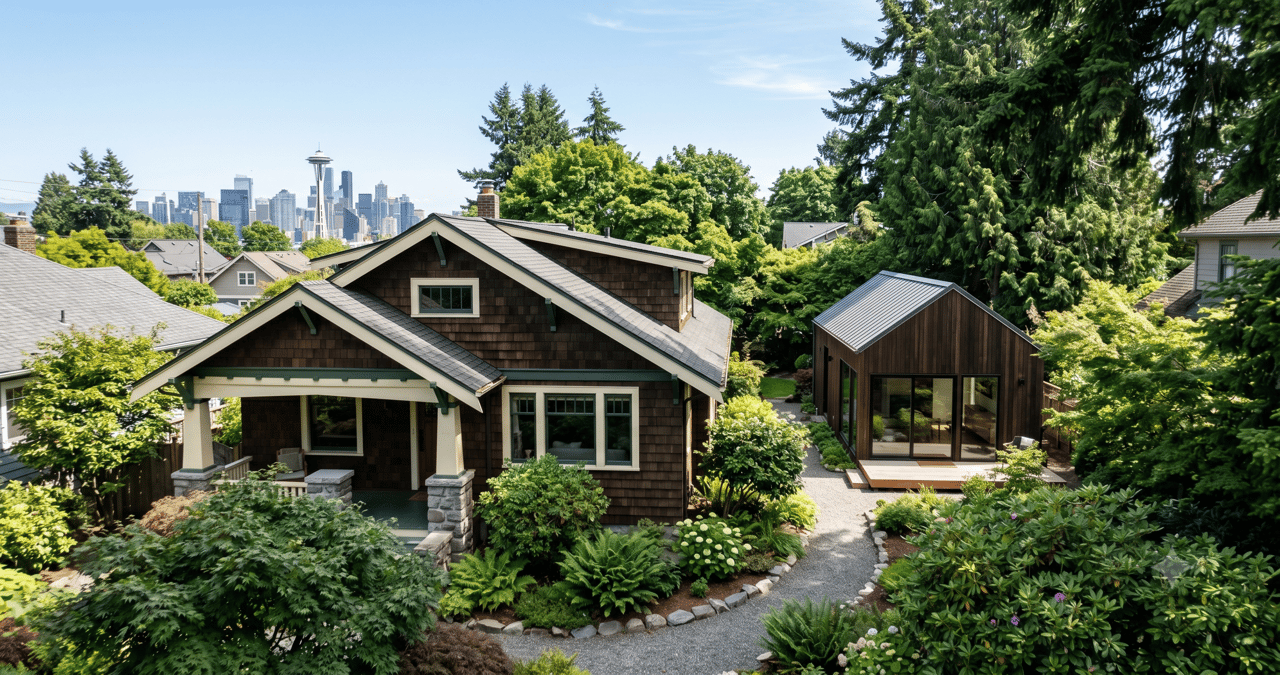
Detached accessory dwelling units (DADUs) sold in Seattle during the past few years have generally traded between $750 k and $1.2 M, depending on size, finish level and neighborhood. Data from a local real-estate report shows that Green Lake and Ballard DADUs sold for about $766 k on average for roughly 1,054 sq ft in 2024, while a high‑end 1,334 sq ft DADU in Ravenna fetched $1.2 million in 2024. (microhouse)These transactions suggest that DADUs typically trade at or below the median price of a standard single‑family home, yet still command a premium because of their scarcity and desirable neighborhoods.
What the Data Shows
Why data matters more than headlines
Seattle’s housing headlines often spotlight soaring prices or unaffordable rents, but the numbers tell a more nuanced story. DADUs - small detached homes built behind or alongside existing houses are part of a wider “middle‑housing” movement that the city has encouraged since 2019. Because DADUs can be sold separately under condominium rules, they provide a unique data set for investors. Looking at verified sources - Northwest MLS (NWMLS), Redfin, U.S. Census Bureau and a city progress report helps investors distinguish between hype and reality.
Data table
Metric | Geography | Timeframe | Value/Observation | Source |
|---|---|---|---|---|
Median sale price (all housing types) | Seattle city | 3 months ending May 2026 | Homes sold for a median $879 k; median price per square foot $569 and median days on market 10. | |
Median sale price (residential + condo) | NWMLS service area | May 2026 | Median price $650 k (down 0.8 % from May 2025); counties with highest median prices were San Juan ($1.125 M), King ($875 k) and Snohomish ($759,875). | |
Average DADU sale price (North Seattle) | Ballard & Green Lake | 2024 | DADUs averaged $766 k for about 1,054 sq ft. | Chris Cross Real Estate Group (local broker report) |
High‑end DADU sale | Ravenna (North Seattle) | 2024 | A 1,334 sq ft DADU with 3 bedrooms/3 baths sold for $1.2 M. | Microhouse (DADU design specialists) |
Average selling price for DADU condos | Seattle city | 2022 | ADU condos sold for $750 k on average, compared with $1.18 M for principal dwellings and $1.6 M for new detached homes. | Seattle Office of Planning & Community Development report via KUOW |
ADU permits issued | Seattle city | 2023 | 987 ADU permits (up from 482 in 2020) were issued; ADUs now outnumber single‑family permits 2 : 1. | KUOW report citing city progress report |
30‑year fixed mortgage rate | United States | 11 June 2026 | 6.52 % weekly average. | FRED / Freddie Mac Primary Mortgage Market Survey |
Population estimate | Seattle city | July 1 2025 | Population 784,777; median household income $123,860; owner‑occupied housing rate 43.7 %. | |
DADUs built | Seattle city | 2022 | 495 DADUs were built, a record year. | Microhouse (DADU design specialists) |
What changed vs. what didn’t
- Permitting and supply: Reforms in 2019 opened the door for more ADUs. By 2023 the city issued 987 ADU permits, quadruple the number issued in 2020. DADUs now outnumber single‑family permits 2 to 1. This surge in supply helps explain why DADU prices haven’t spiked as fast as larger homes.
- Pricing: DADUs sell below the median price of new detached homes. A city report shows ADU condos averaged $750 k, compared with $1.18 M for principal dwellings. This gap may widen if mortgage rates stay near 6.5 % and inventory grows.
- Regional differences: North‑Seattle neighborhoods such as Ballard, Green Lake, Ravenna and Queen Anne remain the epicenter for DADU sales. Prices vary widely: mid‑range units sold around $766 k while high‑end examples reach $1.2 M. In contrast, the median sale price across all King County homes was $875 k in May 2026, illustrating that DADUs still trade at a discount relative to new single‑family residences.
- Market conditions: Overall home prices in Seattle slipped slightly (down 2.3 % year‑over‑year as of May 2026) and inventory is growing. For investors, this creates a more balanced market and potentially more opportunities to acquire or build DADUs without facing bidding wars.
What This Means for Investors
Leverage
For investors seeking a lower‑cost entry into Seattle’s housing market, DADUs offer a smaller capital outlay compared with new detached homes. Average sale prices in the mid‑$700 k range suggest that financing a DADU will require less leverage than a $1 million+ single‑family home, even though construction costs can run $350–$500 per square foot according to builders (not covered in our dataset). With mortgage rates above 6 %, keeping debt loads manageable is crucial.
Behavior
Demand for DADUs is location‑sensitive. Buyers pay premiums for walkable, transit‑oriented neighborhoods (Green Lake, Ravenna, Queen Anne), while units in less central areas trade closer to the median city price. Investors should focus on proximity to amenities, parking access and school districts, factors the city emphasises in its permit reports. Additionally, DADU buyers tend to be owner‑occupiers or extended‑family users, so design quality and livability matter; microhouse notes that thoughtful design can yield $200 per sq ft higher prices.
Positioning
- Buy and hold: Renting out a DADU can provide stable income. A city report notes that one‑third of ADUs are rented long‑term and only 10 % are used as short‑term rentals, suggesting steady demand for long‑term leases.
- Build to sell: If you own land suitable for a DADU, the data show that condo‑style DADUs sold around $750 k and high‑end examples can exceed $1 M. However, market-wide median prices have flattened, so pro‑forma assumptions should be conservative.
- Exit strategy: DADUs are now commonly sold as condominiums 44 % of ADUs were permitted as condos in 2022. This structure allows investors to sell the DADU separately from the main home, potentially unlocking equity without selling the entire property.
What We’re Seeing Locally
At HouseHack Seattle, we regularly discuss DADU deals in our investor channels. Recent conversations highlight three recurring themes:
- North‑Seattle momentum. Several members reported receiving multiple offers on Ballard and Green Lake DADUs priced near the $750 k mark. Listings with private parking and a well‑designed floorplan tend to sell faster than those with alley access only.
- Permit pipelines matter. Investors who filed for permits early in 2023 took advantage of the four‑fold increase in ADU permits. Those who waited faced longer timelines as city staff dealt with nearly 1,000 permit applications.
- Design drives value. A recent microhouse project in Ravenna sold for $1.2 M. The builder attributes this premium to integrated design and a detached garage features that resonate with buyers seeking a “real house” feel rather than a tiny home. This anecdote underscores how quality finishes and thoughtful site planning can command a price well above average.
FAQ
How much does it cost to build a DADU in Seattle?
Construction costs vary widely. Builders quoted ranges of $350 - $500 per sq ft for DADUs in 2025 (numbers from local builders; not part of our official data). For a 1,000 sq ft DADU, that translates to $350k–$500 k, excluding land and permitting fees. Given that some DADUs sell around $750 k, investors should carefully analyze whether the potential spread covers financing, carrying costs and profit margin.
What is the typical size of a Seattle DADU?
Seattle’s land‑use code traditionally limited DADUs to 1,000 sq ft of living space, though some recent projects through design loopholes such as garage conversions have reached 1,334 sq ft. A high‑profile 2024 sale in Ravenna (1,334 sq ft, 3 bed/3 bath) shows that larger DADUs command higher prices. As the city considers more “middle housing” options, future rules may allow up to four units on a lot.
Do DADUs increase property value?
Data from the Seattle Office of Planning & Community Development indicates that ADU condos sold for roughly $750 k in 2022, principal dwellings averaged $1.18 M and new detached homes averaged $1.6 M. This suggests that adding a DADU can substantially increase a property’s total market value, especially if the ADU can be sold as a separate condominium. However, returns vary by neighborhood and design quality high‑end DADUs with premium finishes can exceed $1 M, while smaller or less accessible units may sell closer to $750 k.
How long do DADUs stay on the market?
Overall, homes in Seattle sold in a median of 10 days as of May 2026. DADUs in desirable areas often sell even faster; our contacts reported offers within a week for well‑designed units. However, as inventory grows and interest rates stay elevated, days‑on‑market could extend modestly.
Conclusion
Detached accessory dwelling units are no longer a niche product. Seattle’s permitting reforms have quadrupled the number of ADUs built in recent years, and buyers have demonstrated a willingness to pay $750 k–$1.2 M for a small detached home. For investors, the opportunity lies in carefully selecting neighborhoods, optimizing design, and understanding your cost structure. With mortgage rates above 6 % and overall home prices flattening, a disciplined underwriting approach grounded in real data rather than hype will separate the winners from the speculators.
Stay connected with insights on house hacking, local market trends and smart investing strategies. Our community of 1,000+ investors meets regularly to share practical guidance on ADUs, development, BRRRR, rentals (short‑ and long‑term), property management and more, whether you’re a first‑time buyer or a seasoned investor with multiple projects.
Follow us on social for updates, tips and event details:
Instagram: @househackseattle
Facebook: HouseHack Seattle
Youtube: @HouseHack Seattle
Author Bio: Michael Haas is the founder of HouseHack Seattle and a long‑time real‑estate investor. With over 15 years of experience analysing Pacific Northwest housing markets, he combines boots‑on‑the‑ground insights with rigorous data analysis. Michael’s work has been featured in local publications, and he speaks regularly about accessory dwelling units, housing policy, and ethical investing. His mission is to help investors make informed decisions without relying on hype or hearsay.