
Real estate goals become useful when you convert them into actions you can measure every week. Instead of writing “buy an investment property,” define the property, market, financial target, deadline, weekly activity, and accountability system that would make the result more likely.
That discipline matters in Seattle because investors are working with high property prices, mortgage rates above 6%, and deals that often require more creativity than a standard long-term rental.
What does the current Seattle market data show investors?
Market headlines rarely tell you what to do next. A better approach is to track a small group of numbers that affect your financing, search activity, underwriting, and offer strategy.
The current data shows a market with more available inventory, slightly longer marketing times, and prices that remain high. Borrowing costs have also stayed elevated. That does not tell every investor to buy or wait. It tells investors to create clearer acquisition criteria and review more deals carefully.
Metric | Geography | Timeframe | Latest reading | Original source |
|---|---|---|---|---|
Median listing price | King County | June 2026 | $850,000 | |
Active listing count | King County | June 2026 | 6,913 listings | |
Median days on market | King County | June 2026 | 37 days | |
Median listing price per square foot | King County | June 2026 | $529 | |
Average 30-year fixed mortgage rate | United States | Week ending July 16, 2026 | 6.55% | |
Median household income | Seattle | 2020–2024 estimate | $123,860 |
King County’s median listing price moved from $859,885 in May to $850,000 in June. At the same time, active listings increased from 6,221 to 6,913, while median days on market increased from 36 to 37. Buyers have more properties to review, but the typical asking price remains substantial.
Financing conditions have not changed enough to rescue a weak deal. The average 30-year fixed mortgage rate was 6.55% for the week ending July 16, up from 6.49% one week earlier but below 6.75% a year earlier. Investors still need conservative expense assumptions and a clear plan for creating income or value.
What changed: Investors have more active listings to analyze, and properties are taking slightly longer to leave the market.
What did not change: Seattle-area property prices and borrowing costs remain high enough that vague criteria, optimistic rent estimates, and passive searching can quickly waste time.
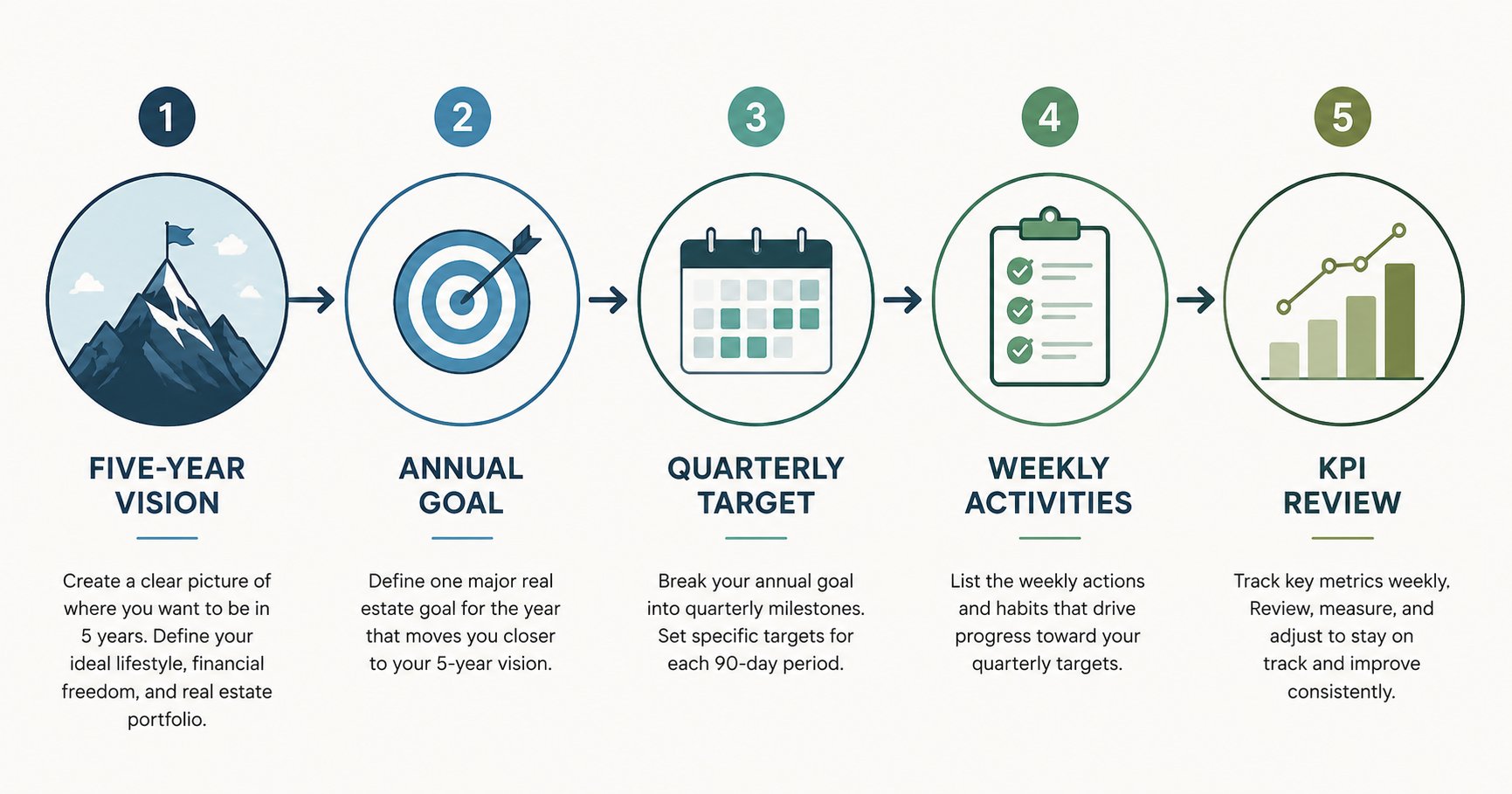
How should investors turn a broad goal into measurable action?
During a HouseHack Seattle presentation, investor Marty Krimmel shared the framework he uses to connect long-term ambitions with weekly behavior. His central point was simple: good intentions are not enough. Investors need a repeatable process that shows whether they are actually moving forward.
The framework starts with six practical steps.
1. Tell the truth about where you are today
Before setting a target, document your current position.
For an investor, that may include:
- Cash available for a down payment and reserves
- Current monthly cash flow
- Personal and business debt
- Financing capacity
- Number of properties owned
- Hours available each week
- Experience with renovations, tenants, or property management
Avoid evaluating yourself with broad labels such as “doing well” or “falling behind.” Record the actual numbers.
A buyer with $150,000 available, stable income, and renovation experience should not use the same plan as a first-time investor with limited reserves. Both may reach a worthwhile goal, but the next actions will be different.
2. Define why the goal matters
A goal is harder to abandon when it is connected to a specific reason.
“Financial freedom” is usually too abstract. A more useful explanation might be:
- Replace $3,000 of monthly employment income
- Create housing for an aging parent
- Reduce personal housing costs through a house hack
- Build enough flexibility to work fewer hours
- Purchase one property that can be held for at least ten years
The purpose does not need to sound impressive. It needs to be personally meaningful enough to keep you engaged when a deal fails, financing changes, or a contractor quote comes in higher than expected.
3. Describe the investor you want to become
Your five-year vision should describe both the financial result and the person capable of producing it.
For example:
I am a disciplined Seattle housing investor who understands small multifamily properties, maintains adequate reserves, makes decisions from verified numbers, and owns rentals that support my family without requiring constant intervention.
This is more useful than simply saying, “I want ten properties.” It defines how you intend to evaluate, purchase, and operate those properties.
4. Write one specific annual goal
An annual real estate goal should identify:
- Property type
- Target market
- Investment strategy
- Financial requirement
- Deadline
One example discussed during Marty’s presentation was a goal to purchase a Seattle triplex through house hacking by December 31, with at least $200 in projected monthly net cash flow.
The exact numbers will be different for every investor. The value of the example is its precision. You can determine whether a property meets the requirement instead of changing the requirement whenever a new listing appears.
A clear annual goal could read:
By December 31, I will purchase one duplex, triplex, or property with a permitted additional unit in North Seattle for no more than $950,000. The property must pass my reserve, repair, and rental-income requirements under conservative financing assumptions.
This is a planning standard, not a prediction that a qualifying property will appear.
5. Break the annual goal into quarterly targets
A purchase goal usually contains several smaller projects.
Quarter 1: Prepare the finances
- Confirm financing options
- Establish the maximum monthly payment
- Build the required down payment and reserve fund
- Review personal expenses
- Decide which funds cannot be used for the purchase
Quarter 2: Learn the target market
- Select two or three neighborhoods
- Study recent comparable sales
- Track asking rents
- Review zoning and permitted-use information
- Analyze a fixed number of properties each week
Quarter 3: Submit offers
- Tour properties that meet the criteria
- Confirm renovation and operating assumptions
- Submit a defined number of supportable offers
- Track why each offer was accepted, rejected, or withdrawn
Quarter 4: Close and carry out the property plan
- Complete inspections and due diligence
- Finalize financing
- Schedule contractors
- Prepare the rental unit
- Establish management and bookkeeping processes
This structure prevents an investor from spending the entire year “researching” without reaching the activities that could lead to a purchase.
What weekly activities should a real estate investor track?
Marty organizes weekly execution into four categories: habits, actions, constraints, and key performance indicators.
Habits
Habits are recurring activities that keep the investment process moving.
Examples include:
- Analyze five listings every week
- Review finances every Friday
- Spend two hours in the target neighborhood
- Speak with a lender or broker once a month
- Review rental listings every Monday
- Contact one property manager or contractor each week
Habits should support the annual goal. Attending events and watching videos may be useful, but they cannot replace underwriting or making offers.
Actions
Actions are specific tasks that need to be completed once.
Examples include:
- Secure a loan preapproval
- Build an underwriting spreadsheet
- Tour a selected neighborhood
- Request an insurance estimate
- Interview three property managers
- Submit an offer
- Obtain a sewer-scope estimate
Each weekly plan should contain at least one action that moves the investor closer to a decision.
Constraints
Constraints define what you will not pursue.
They protect you from changing direction every time a different strategy appears attractive.
Useful constraints may include:
- No properties outside the selected neighborhoods
- No offers without verified rent assumptions
- No projects requiring more cash than the established reserve limit
- No short-term rental underwriting unless the use is permitted and independently supported
- No property that only works under aggressive appreciation assumptions
- No new investment strategy until the current one has been tested for a full quarter
A strong “no” can be as useful as another task on the calendar.
Key performance indicators
KPIs show whether you are performing the activities that could reasonably produce the goal.
A weekly investor scorecard could track:
Activity | Weekly target | Actual result |
|---|---|---|
Properties reviewed | 10 | |
Full underwriting analyses completed | 5 | |
Property tours | 2 | |
Contractor or manager conversations | 1 | |
Offers submitted | 1 | |
Dollars added to reserves | $500 | |
Accountability reviews completed | 1 |
The purpose is not to create a perfect score every week. It is to reveal the difference between feeling busy and completing the work connected to the goal.
Why is making offers more useful than endless analysis?
Many aspiring investors become skilled at collecting information but never test their assumptions in the market.
They watch property tours, attend events, complete courses, and analyze listings. Those activities can build knowledge. They do not create a purchase opportunity unless the investor eventually communicates an offer a seller can consider.
During the presentation, Marty used 20 offers in one quarter as an example of a measurable activity target. That was not a promise that the twentieth offer would be accepted. It was a way to replace “I am looking for a property” with an observable behavior.
There is no universal offer target. An investor reviewing large apartment buildings may make fewer offers than a buyer pursuing small residential properties. The target should reflect the strategy, market, underwriting requirements, and time available.
The larger point is that investors should measure the activity that directly connects to the intended result.
How does accountability change investor behavior?
Investors often perform structured reviews at work but do not apply the same discipline to their personal finances or property goals.
A weekly accountability appointment creates a clear moment when progress must be reviewed. That meeting could be with:
- A spouse or partner
- Another investor
- A real estate agent
- A lender
- A coach
- A small investor group
The review does not need to be long. A useful weekly conversation can answer four questions:
- What did I commit to doing?
- What did I complete?
- What prevented the remaining work?
- What will I complete before the next meeting?
Marty also described using financial consequences and personal rewards to strengthen commitments. Those tools are optional. The important part is creating a structure that does not depend entirely on feeling motivated.
What are we seeing locally among Seattle investors?
In HouseHack Seattle conversations, one of the most common problems is not a total lack of opportunity. It is a lack of defined criteria.
An investor may begin by looking for a Seattle duplex, switch to an Eastside townhome, consider a Tacoma short-term rental, explore an out-of-state property, and then return to a DADU project. Each strategy may be worth studying, but switching constantly prevents the investor from building useful market knowledge.
The investors who make clearer decisions usually narrow their focus:
- One primary market
- One or two property types
- A defined price range
- A specific rental or value-add strategy
- A reserve requirement
- A minimum acceptable return
- A written list of reasons to reject a deal
Marty’s own examples included a Ballard fixer-upper duplex with additional-unit potential and a Burien room-rental project. He described building roughly 19 units over several years rather than purchasing them all at once. His emphasis was consistency over a long period, not rapid unit growth.
He also discussed hiring property managers when the economics and personal capacity supported it. The benefit was not limited to collecting rent or handling tenant communication. A manager introduced him to contractors who later became important members of his renovation team.
That experience does not mean every investor should hire management immediately. It shows why the lowest visible fee is not always the only factor. Time demands, local relationships, maintenance response, leasing knowledge, and operational risk should also be considered.
What happens when motivation disappears?
Most long-term goals include periods when progress is difficult to see.
An investor may analyze properties for several months without finding one that meets the criteria. An offer may be rejected. A renovation estimate may make a promising deal unusable. A lender may change the required terms.
The solution is not to wait for motivation to return. It is to keep the process small enough to continue.
Marty uses a “never more than 48 hours” rule for recurring habits. Missing one scheduled activity does not require abandoning the plan. The investor simply avoids missing the activity twice in a row.
For real estate, that may mean:
- Missing Monday’s underwriting session but completing it Tuesday
- Skipping one weekly market review but not two
- Losing one offer and reviewing the next property within 48 hours
- Pausing after a difficult renovation update but scheduling the next contractor check-in
Consistency does not require flawless execution. It requires returning to the process before a short interruption becomes a long one.
Watch the Full Recording on YouTube
Frequently asked questions
How do I set a realistic real estate investing goal?
Start with your financing capacity, cash reserves, available time, property experience, and target location. Then write a goal that includes the property type, price range, strategy, financial requirement, and deadline.
A goal should challenge you without depending on assumptions you cannot control.
What should a beginner investor track every week?
Track the activities that build knowledge and create opportunities:
- Listings reviewed
- Full analyses completed
- Neighborhood visits
- Professional conversations
- Property tours
- Offers submitted
- Money added to reserves
Avoid relying only on the number of hours spent “working on real estate.”
How many properties should I analyze before making an offer?
There is no fixed number. Analyze enough properties to recognize normal pricing, rents, repair conditions, and deal structures in your selected market.
Once you understand the range and a property meets your criteria, continued analysis should not become a reason to avoid deciding.
How many offers should I make?
Choose an activity target based on your strategy and the number of qualifying properties available. The target should encourage action without pressuring you to submit unsupported offers.
One investor may target one offer per week. Another may target several per quarter. Quality and consistent underwriting still matter.
Is 2026 a bad time to invest in Seattle?
Current data shows increased King County inventory, slightly longer marketing times, high listing prices, and mortgage rates in the mid-6% range. Those conditions make some deals difficult, but the data alone cannot determine whether a specific property fits your finances or strategy.
Evaluate each property using realistic income, vacancy, maintenance, capital-expenditure, financing, and management assumptions.
Should I wait for mortgage rates to fall?
Waiting for a specific rate is a market-timing decision. Instead, underwrite properties using the financing available today.
A future refinance may improve a property’s performance, but the original purchase should not depend entirely on an uncertain rate change.
Is house hacking too much work?
House hacking can require more involvement than a passive rental, particularly when rooms are rented separately or the property needs renovation.
Investors can reduce the workload by choosing newer construction, a property with a separate unit, fewer tenants, professional management, or a simpler renovation plan. The strategy should match your household and tolerance for involvement.
Should I hire a property manager?
Consider management when the fee fits the property’s operating plan and the time, leasing knowledge, maintenance coordination, or local relationships would materially help you.
Include the full management cost in your underwriting before purchasing. Do not treat professional management as a future expense that the property may somehow absorb.
What should I do first after reading this?
Choose one annual goal, three weekly activities, and one person who will review your progress with you.
Run that system for 30 days before adding more habits or changing strategies.
Conclusion
A real estate goal does not need to be complicated. It needs to be specific enough that you can tell whether this week’s actions supported it.
Start with the truth about your finances and capacity. Choose one market and strategy. Define an annual result, break it into quarterly projects, and track a few weekly activities. Then review those activities with another person consistently.
The market will continue to change. A clear process gives you a way to respond without rebuilding your entire plan around every headline.
Author bio
Michael Haas is a Seattle real estate agent, investor, and short-term rental host who leads HouseHack Seattle. He works with buyers and investors evaluating house hacks, ADUs and DADUs, small multifamily properties, renovations, and rental strategies across the Seattle area.
Through HouseHack Seattle events and educational content, Michael brings together investors, housing professionals, lenders, builders, and property operators to discuss local deals and practical ownership decisions. His approach focuses on accurate property analysis, clear assumptions, and helping investors select strategies that fit their finances and long-term plans.