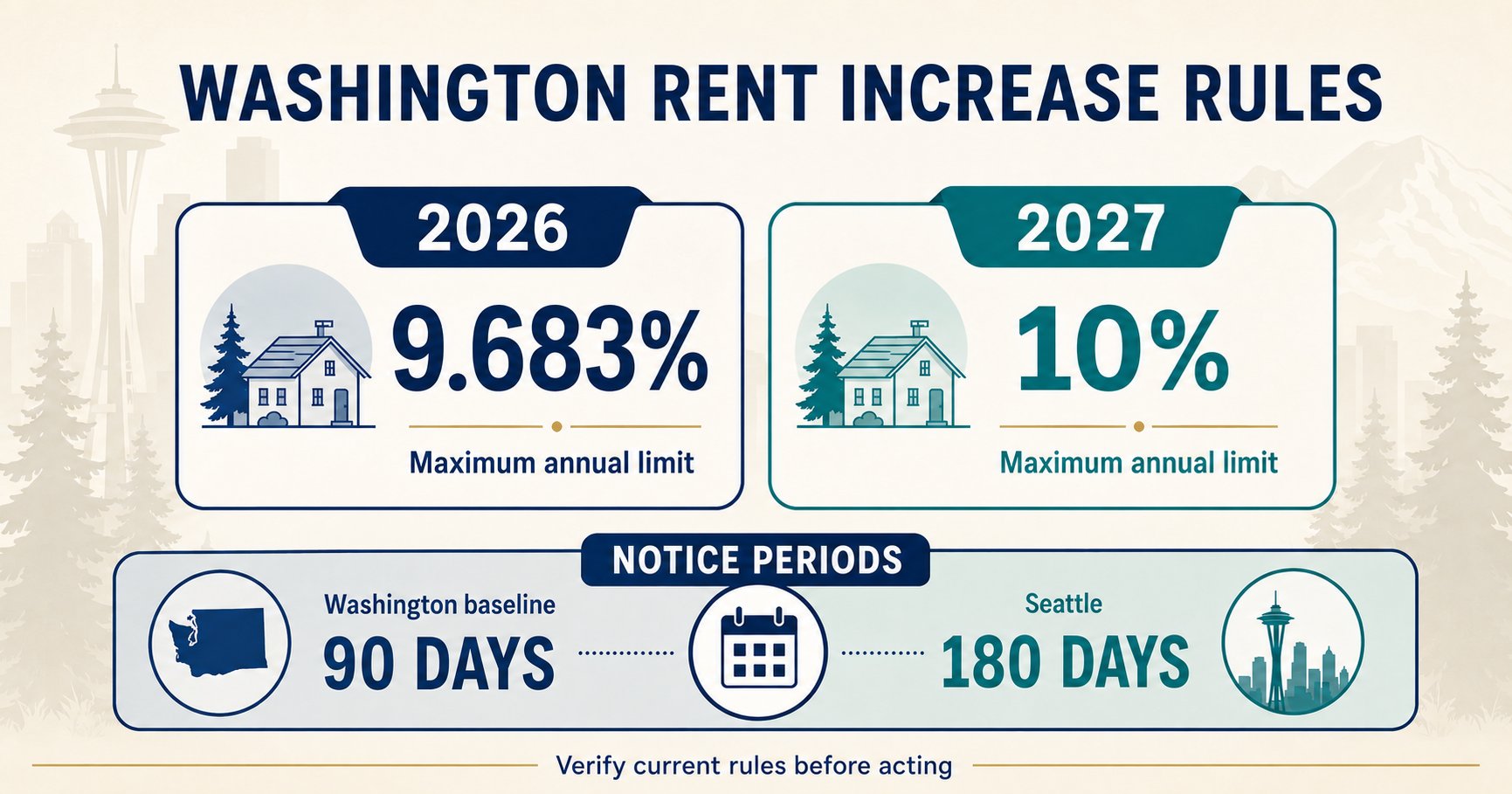
Washington's maximum annual rent increase for covered residential tenancies is 10% from January 1 through December 31, 2027. That is only the statewide ceiling: Seattle's 180-day notice rule, required state forms, and possible relocation-assistance requirements still matter, while some owner-occupied house hacks may qualify for narrow state exemptions.
This article summarizes public sources available July 31, 2026, for general education. It is not legal, tax, lending, or investment advice. Rental rules are fact-specific and can change, so confirm a property or notice with the appropriate local agency and a Washington landlord-tenant attorney.
A house hack is an owner-occupied property where the owner rents bedrooms or separate units to offset housing costs. An accessory dwelling unit (ADU) is an additional home on the same lot; a detached accessory dwelling unit (DADU) is physically separate, often in the backyard.
What does Washington's 2027 rent-limit data actually show?
The headline number is 10%, but the calculation matters. Washington generally limits a covered tenancy's increase to 7% plus the June 12-month change in the Seattle-area Consumer Price Index (CPI), or 10%, whichever is lower. The Washington Department of Commerce publishes the percentage for the following calendar year.
Metric | Geography | Timeframe | Confirmed value or rule |
|---|---|---|---|
Consumer Price Index for All Urban Consumers (CPI-U) used in the formula | Seattle-Tacoma-Bellevue metropolitan area, covering King, Pierce, and Snohomish counties | 12 months ending June 2026 | |
Maximum annual increase for covered residential tenancies | Washington State | January 1-December 31, 2026 | |
Maximum annual increase for covered residential tenancies | Washington State | January 1-December 31, 2027 | |
Increase during a covered tenancy's first year | Washington State | First 12 months after the tenancy begins | |
General advance-notice period | Washington State | Current law as reviewed July 31, 2026 | |
Seattle advance-notice period | Seattle city limits | Current local rule as reviewed July 31, 2026 | |
Economic Displacement Relocation Assistance (EDRA) threshold | Seattle city limits | A single or cumulative housing-cost increase of at least 10% within 12 months |
The June 2026 CPI figure is not Seattle rent growth. It measures price changes across a fixed basket of consumer goods and services in a three-county metropolitan area. Washington uses that regional index as one input in its statewide formula; it does not describe rent changes in Seattle neighborhoods or individual buildings.
Using Commerce's unrounded index values, 7% plus the applicable CPI change produced approximately 11.53% for 2027. Because the statute uses the lower of that result or 10%, the published 2027 maximum is 10%. The state form also makes clear that a landlord is not required to increase rent by any amount.
What changed is the annual published ceiling: it is 9.683% during calendar year 2026 and 10% during calendar year 2027. What did not change is equally important: the first-year restriction, the 12-month measurement period, the exemption criteria, the notice process, and Seattle's longer local timeline remain separate questions.
How can the 2027 limit affect investment underwriting?
For an investor, 10% should be treated as a ceiling to investigate, not a default rent-growth assumption. The amount available in a particular year depends on the tenancy's start date, prior increases, recurring charges, exemption status, required notice, and local rules. Market rent and the legal maximum are different inputs.
A conservative underwriting model should begin with the actual rent roll the list of units, tenants, rents, and lease terms and the lease history. It should test several scenarios, including no increase, a moderate increase, tenant turnover, higher operating expenses, and an extended vacancy. A deal should not depend on automatically applying the statutory maximum.
The state notice form describes the rental amount as including recurring or periodic charges identified in the agreement for use and occupancy. That makes the full lease and fee schedule important. Reviewing only the line labeled “base rent” may miss charges that matter to the state calculation or Seattle's broader housing-cost rules.
Timing is also an operating variable. Washington's general notice period is at least 90 days, but Seattle requires at least 180 days for housing-cost increases. A buyer evaluating near-term income should verify whether a valid notice already exists rather than assuming a higher rent can take effect immediately after closing.
Washington's statute does not limit a rent adjustment after a tenant genuinely vacates and the tenancy ends. That provision is not permission to force turnover, and it does not replace Seattle's other tenant protections. It simply means an occupied-unit projection and a post-vacancy market-rent projection should be modeled separately.
Which house hacks may fall under a state exemption?
Washington's exemption section contains several property- and occupancy-specific categories. These are screening questions, not automatic conclusions. A state cap exemption also should not be treated as an exemption from Seattle's separate notice, form, or relocation-assistance requirements without property-specific confirmation.
House-hack situation | What the state statute says to examine | Practical verification |
Owner and tenant share a kitchen or bathroom | A potential exemption exists when the owner maintains a principal residence at the property and shares one of those facilities with the tenant. | Confirm principal residence, the actual shared facilities, title, and ownership structure. |
Owner occupies a single-family residence and rents a room, ADU, or DADU | A potential exemption covers an owner-occupied single-family residence with no more than two rented units or bedrooms, including an attached or detached accessory dwelling unit. | Count every rented unit or bedroom and document continued owner occupancy. |
Owner occupies a duplex, triplex, or fourplex | A potential exemption applies when the owner occupied a unit as a principal residence at the beginning of the tenancy and continues to occupy it. | Check each tenancy's start date against the owner's occupancy history. |
Newer dwelling unit | A separate exemption may apply when the first certificate of occupancy—the official record authorizing occupancy—was issued no more than 12 years before the rent-increase notice. | Verify the first certificate-of-occupancy date, not merely a permit or construction date. |
Real estate investment trust (REIT), corporation, or certain LLC ownership | The owner-occupied exemptions above do not apply when the owner is a REIT, a corporation, or an LLC with at least one corporate member. | Review the deed and entity records with counsel; do not infer the answer from the listing. |
The source for this screening table is RCW 59.18.710. If an owner claims an exemption to increase rent above the standard limit, RCW 59.18.700 requires supporting facts in the written notice and points back to the state notice, form, and service provisions.
What are we seeing locally in Seattle house-hack decisions?
In HouseHack Seattle's work with buyers and owners, the recurring issue is rarely the published percentage by itself. The harder question is how the property's physical layout, tenancy history, owner occupancy, and ownership structure fit together. A duplex, DADU, or rented bedroom does not answer that question on its own.
We also see a practical gap between acquisition underwriting and property management. A projected financial model, often called a pro forma, may show one clean annual rent-growth line. The property may instead have different tenancy start dates, informal fee arrangements, older leases, and incomplete notices that change the timing and reliability of projected income.
The following examples are hypothetical and designed to show what to investigate. They are not conclusions that a particular property is exempt or that a proposed increase complies with state or local law. The underlying documents and professional review remain essential.
What should an owner renting a bedroom investigate?
Suppose an owner lives in a Seattle home and rents one bedroom while sharing the kitchen. The shared-facility exemption may be relevant, but the analysis does not stop there. The owner should verify principal-residence facts, ownership structure, the number of rented rooms or units, the state notice form, and Seattle's local requirements.
What should an owner renting a backyard DADU investigate?
Suppose an owner lives in the main house and rents one detached accessory dwelling unit. The single-family owner-occupied exemption may be relevant because the statute includes attached and detached ADUs, but the owner still needs to verify the unit count, continued occupancy, entity structure, notice language, and Seattle-specific process.
What should a buyer of an owner-occupied fourplex investigate?
Suppose a buyer plans to occupy one unit in a fourplex with existing tenants. The statute refers to owner occupancy at the beginning of the tenancy and continued occupancy. That makes the existing tenancy dates and prior owner's occupancy history material; a future plan to move in is not enough information to classify the tenancies.
What should an investor in a newly completed unit investigate?
Suppose a recently completed unit received its first certificate of occupancy within the prior 12 years. The newer-unit exemption may be relevant, but the recorded date needs to be confirmed. A building permit, final inspection, listing statement, or construction-completion estimate is not the same document named in the statute.
What should you investigate before buying or developing a rental property?
The useful due-diligence question is not simply, “What is the market rent?” It is, “What facts determine when and how the current rent can change?” Before relying on rental growth in a Seattle house hack, ADU, DADU, or two-to-four-unit property, investigate the following records and assumptions:
- Confirm jurisdiction. Verify that the property is inside Seattle city limits rather than relying on a Seattle mailing address.
- Map every tenancy. Record each tenant's start date, lease term, renewal date, current rent, and recurring fees.
- Review the prior 12 months. Identify every rent or housing-cost increase and its effective date.
- Inspect notices and service records. Request the completed forms, supporting exemption facts, delivery dates, and proof of service.
- Verify owner occupancy. Compare principal-residence claims with the timing required for the relevant property type.
- Review title and entity structure. Identify the legal owner and any corporate member before assuming an owner-occupied exemption applies.
- Confirm the first certificate of occupancy. Use the official record for any newer-unit exemption analysis.
- Screen for Seattle EDRA. If a proposed increase reaches 10%, confirm the current notice and application process with the City.
- Stress-test the deal. Model lower rent growth, no near-term increase, turnover costs, vacancy, repairs, and higher operating expenses.
- Use the right professionals. Ask a landlord-tenant attorney about compliance, a property manager about operations, and a lender or accountant about financing or tax questions.
What do Seattle owners and buyers most often ask about the 2027 rent cap?
What is Washington's rent increase limit for 2027?
For residential tenancies covered by RCW 59.18.700, the Washington Department of Commerce has published a maximum annual increase of 10% for January 1 through December 31, 2027. Exemptions and additional notice requirements can change how the rule applies to a specific tenancy.
Can a Washington landlord automatically raise rent by 10% in 2027?
No. Ten percent is the ceiling for a covered tenancy, not an automatic entitlement or recommended increase. The first 12 months, prior increases, lease term, required state form, service rules, exemptions, and local requirements all matter. The property's market position and the value of retaining a good tenant are separate business considerations.
Does Washington's rent cap apply to an owner-occupied duplex?
Possibly, but the property label alone does not decide it. RCW 59.18.710 includes a potential exemption for an owner-occupied duplex, triplex, or fourplex when the owner occupied a unit at the beginning of the tenancy and continues to do so, subject to ownership restrictions.
Does the state cap apply to a Seattle ADU or DADU?
It depends on the facts. The state statute includes attached and detached accessory dwelling units within a potential owner-occupied single-family exemption when no more than two units or bedrooms are rented. Newer units may have a separate certificate-of-occupancy exemption. Seattle's local rules still require their own review.
Is the rent-increase notice period 90 days or 180 days in Seattle?
Washington generally requires at least 90 days' written notice. Inside Seattle city limits, the City requires at least 180 days' advance written notice for a housing-cost increase. Housing providers should also use the current state form and follow the applicable service rules.
Can a 10% increase trigger Seattle's EDRA process?
Yes, it can. Seattle's guidance says a single or cumulative housing-cost increase of at least 10% within 12 months can make a household earning no more than 80% of area median income eligible to apply if it moves. Eligibility, notice, timing, and payment are process-specific rather than automatic.
What happens to the state cap after a tenant moves out?
RCW 59.18.700 says the cap does not prohibit a rent adjustment after the tenant vacates and the tenancy ends. A new tenancy then begins its own timeline, including the rule against an increase during its first 12 months, unless a valid exemption applies.
What is the practical takeaway for a Seattle house hack?
The 2027 headline is simple: Washington's published maximum is 10% for covered tenancies. The investment decision is not. A property's city boundary, rent history, fee structure, owner occupancy, tenancy dates, certificate of occupancy, and legal ownership can all affect the analysis before projected rent growth reaches a spreadsheet.
The strongest house-hack underwriting is grounded in the income that exists today and tested against conservative alternatives. If you are evaluating a room rental, ADU, DADU, or small multifamily property, start by organizing the facts. That creates better questions for your broker, property manager, lender, accountant, local agency, and attorney.
If you want to compare how those facts affect the real estate side of a potential Seattle purchase, HouseHack Seattle is always open to a grounded conversation. There is no need to force a deal—or a rent assumption—before the records support it.
About Michael Haas
Michael Haas is a Seattle-area Real Estate Agent and Investor affiliated with Compass, an active real estate investor, and the founder of HouseHack Seattle. His current Compass profile says he owns 17 rentals and five Airbnbs, has built five DADUs and homes, has participated in more than 50 renovation projects, and has helped more than 200 clients use real estate.
Michael's work focuses on house hacking, ADUs and DADUs, long- and short-term rentals, waterfront homes, and practical property analysis. HouseHack Seattle combines brokerage experience with investor education so buyers and owners can evaluate opportunities with clearer assumptions, stronger due diligence, and the right professional team for property-specific questions.
Primary Sources Used
- Washington Department of Commerce: HB 1217 Landlord Resource Center
- RCW 59.18.700: Rent-increase limits, notices, and enforcement
- RCW 59.18.710: Exemptions
- RCW 59.18.720: Required rent-and-fee increase notice form
- RCW 59.18.140: State notice period
- RCW 59.12.040: Service and proof of service
- U.S. Bureau of Labor Statistics: Seattle-area CPI, June 2026
- City of Seattle: Housing Cost Increases
- City of Seattle: Economic Displacement Relocation Assistance
- Compass: Michael Haas professional profile