Seattle put two housing-process changes in the spotlight in August 2026. They sound similar in a headline, but they operate on different parts of the system. One concerns the permit path for individual projects. The other concerns how Seattle handles environmental appeals tied to citywide planning and development regulations.
That distinction matters if you are evaluating a DADU, ADU, fourplex, stacked-flat conversion, cottage cluster, or development-capable lot. A policy change can reduce one kind of delay without changing the zoning, trees, drainage, utility work, building code, financing, or construction cost that determines whether a specific property works.
What do the official documents show?
The most useful facts are the dates, scope, and implementation status in the City's own records. They show real action, but not measured permit-time improvement yet. The table separates current directives from future proposals and deadlines so buyers do not confuse an announced process with a completed result.
Source note: Policy and legal claims use official City of Seattle records. No unverified market statistic is used in this article.
What changed - and what did not?
The executive order directs near-term coordination across departments and launches a residential interdepartmental team. It also tells SDCI to help low-income housing developers navigate cross-department processes, with an emphasis on community-driven development. Better handoffs may reduce avoidable delay, but the City has not yet published performance results proving shorter end-to-end timelines.
Ordinance 127477 is narrower than a general permit reform. It removes the Seattle Hearing Examiner's administrative appeal for a SEPA threshold determination or EIS adequacy associated with a proposed Comprehensive Plan or development regulation. The signed text also adds waiting and comment provisions for decisions that are exempt from that administrative appeal.
The ordinance does not eliminate SEPA, public comment, project-based appeals, or state-required review routes. The City Council's FAQ says project-based SEPA appeals remain and identifies the King County Superior Court and Growth Management Hearings Board as continuing state-required avenues. Property-specific legal questions should still go to land-use counsel.
How do the two permit clocks affect an investor?
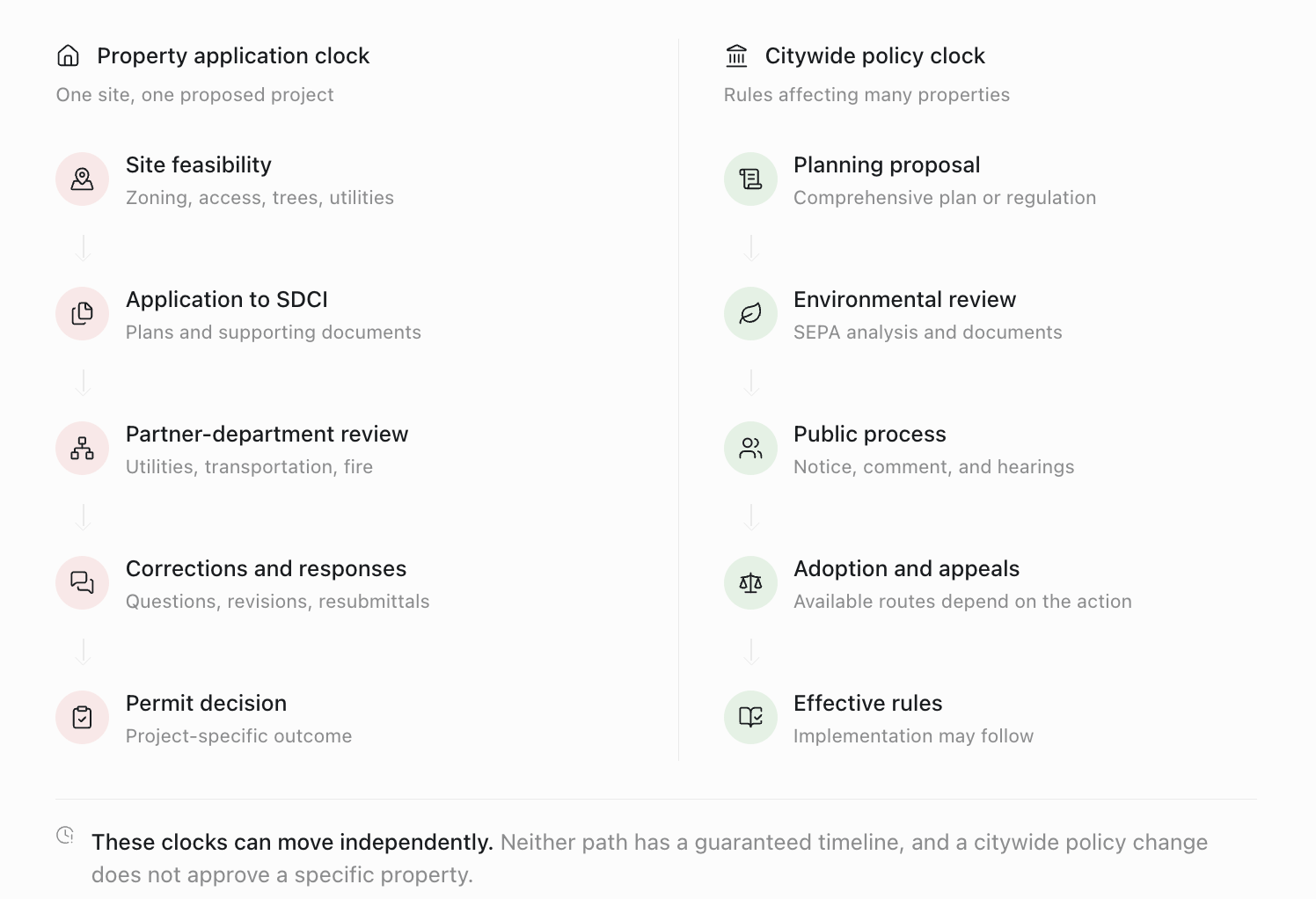
A practical way to read the changes is to separate the property clock from the policy clock. The clocks can influence each other, but they do not start, stop, or finish at the same time. That is why a citywide reform should not be treated as proof that one backyard cottage will receive a permit by a particular date.
The property clock
The property clock covers one address: intake, plan completeness, corrections, zoning review, building review, drainage, trees, utilities, transportation, fire access, applicant response time, and issuance. Executive Order 2026-4 is aimed mainly at the handoffs among departments on this clock, especially when several agencies need to resolve connected questions.
The policy clock
The policy clock covers Seattle's broader planning work: comprehensive-plan implementation, development regulations, environmental documents, public comment, legislative action, and appeals. Ordinance 127477 acts mainly on this clock by changing the local administrative appeal route for certain legislative SEPA decisions. It does not grant an individual project approval.
For investors, the takeaway is simple: underwrite the property clock using today's code and a realistic review sequence. Treat future zoning, task-force recommendations, or hoped-for coordination gains as upside only after the City publishes operative rules, procedures, and results. A listing's development language is a starting point, not a feasibility conclusion.
What does this mean for ADU, DADU, and small-infill buyers?
The reform may make it easier for City staff to coordinate when SDCI, City Light, Seattle Public Utilities, SDOT, and Seattle Fire all touch a project. That is meaningful because a technically sound design can still lose time at a handoff. The order, however, does not waive any department's underlying requirements.
Do not pay a 'permit reform premium' merely because the headlines sound favorable. Confirm the code in force, the site's physical constraints, the utility concept, and the likely correction cycles. The purchase should make sense under a defensible base case; untested development potential should be a second scenario, not the only route to a workable deal.
Current zoning still controls the unit count and development standards used in today's feasibility work. For a fuller review of those rules, see HouseHack Seattle's 2026 Neighborhood Residential zoning guide. For purchase-market context, the July 2026 investor market update provides a separate look at inventory, pricing, and buyer leverage.
What are we seeing locally when buyers review a property?
In property-level conversations, the most useful early question is rarely, 'How many units might be allowed?' A better question is, 'What has to be true for this site to work under today's rules?' That shift forces the team to identify the assumptions that can actually break the schedule or budget.
West Seattle DADU example
A homeowner considering a backyard cottage still needs to verify trees, setbacks, lot coverage, drainage, utility connections, access, and construction cost. Better City coordination may help if several departments are involved, but it does not remove those reviews. A realistic plan carries time and cost reserves before design work becomes expensive.
Beacon Hill fourplex or stacked-flat example
A buyer should model the zoning and development standards in force on the evaluation date. The SEPA appeal change affects certain City legislative actions, not the approval of the buyer's concept. Unless the contract clearly prices entitlement risk, the acquisition should not depend on a future City recommendation becoming law.
Rainier Valley community-driven housing example
A low-income or community-driven project may have a more direct connection to the executive order's navigation support. The team should still confirm who qualifies, how to request assistance, and whether a written procedure exists. An announced support pathway is useful, but it is not a substitute for a complete application and professional review.
North Seattle utility-and-fire example
A small-infill project with utility capacity, access, and fire questions may benefit when departments have named coordination contacts. That is the intended process gain. The applicant still needs accurate drawings, complete technical information, and timely responses. Coordination can help a project move; it cannot make an incomplete or noncompliant submittal approvable.
What should you verify before an offer or design contract?
Confirm the rules in force. Check current zoning, allowed uses, unit count, dimensional standards, and the permit path for the exact project type.
Pull the property record. Review prior permits, correction letters, surveys, easements, title items, utility correspondence, and any earlier feasibility work.
Map every reviewer. Ask the architect or permit consultant to identify SDCI, City Light, SPU, SDOT, Fire, tree, drainage, and critical-area issues.
Test the site before polishing the design. Resolve access, grading, trees, utilities, parking assumptions, and structural constraints while changes are still inexpensive.
Model more than the first review. Include intake, correction cycles, applicant response time, utility design, contractor pricing, and issuance in the schedule.
Separate the base case from the upside case. The existing property should have a defensible plan before future zoning or process improvement is credited.
Protect the due-diligence window. Match inspection, feasibility, financing, appraisal, and title work to the actual risk in the property and offer.
Use the right professionals. Brokers can frame transaction questions; architects, engineers, contractors, lenders, land-use counsel, and tax advisers should cover their licensed areas.
What should investors watch in 2027?
The next useful signals will be implementation details, not another headline. Watch for a published way to reach the interdepartmental team, any eligibility rules for SDCI navigation support, permit-performance reporting, and the 2027-28 budget decision on the proposed Affordable Housing Ombuds. Those items will show whether the announced structure becomes usable.
February 2027: Housing Production Task Force status update and 2027 policy recommendations.
March 1, 2027: OPCD report on options for more uniform review guidance under Seattle's SEPA policies.
During the 2027-28 budget process: Decision on proposed funding for an Affordable Housing Ombuds.
September 2027: Final task-force recommendations for 2028 and 2029.
Before relying on any milestone, recheck the official page. Task-force schedules, budgets, staffing, contact procedures, and planning phases can change. The right investment decision uses the newest operative rule and a site-specific review, not an older announcement saved in a deal folder.
Frequently asked questions
Will a normal Seattle ADU or DADU permit move faster now?
Possibly, but it is too early to claim that as a measured outcome. The executive order is designed to improve coordination and predictability. It does not promise a completion date, and total timing still depends on project complexity, application quality, corrections, utilities, and other reviews.
Did Executive Order 2026-4 change Seattle zoning or unit counts?
No. The order creates coordination and advisory structures. It does not rezone a property, approve a particular number of units, cut permit fees, or waive building and site requirements. Use the zoning and development standards in force when you evaluate the property.
Did Seattle eliminate SEPA or all environmental appeals?
No. Ordinance 127477 changes the local administrative appeal route for SEPA decisions tied to proposed comprehensive plans and development regulations. The City Council says project-based SEPA appeals and state-required routes remain. A land-use attorney should assess any specific appeal question.
Is the Affordable Housing Ombuds already funded and operating?
Not based on the August 19 announcement. The mayor said funding would be proposed in the 2027-28 budget. Investors should not assume the position exists, has staff, or is available until the City confirms those details.
Which departments can touch a small residential project?
SDCI is the central permitting department, but City Light, Seattle Public Utilities, SDOT, and Seattle Fire may also be involved. Trees, drainage, access, critical areas, and utility capacity can add specialized review. The exact list depends on the site and project.
Do these changes apply in Bellevue, Redmond, Shoreline, Bothell, or Renton?
No. These are City of Seattle actions. Other cities have their own zoning codes, permit departments, appeal procedures, fees, and timelines. A property outside Seattle needs a separate jurisdiction-specific review.
What is the safest way to value development potential?
Start with the property's current use and rules, then build a separate development case using professional feasibility work. Discount uncertain timing and cost assumptions. Do not rely on marketing language, a citywide task-force announcement, or a future zoning theory as if it were an issued permit.
What is the grounded takeaway?
Seattle's 2026 actions are meaningful because coordination and legislative process can affect cost and timing. They are not a shortcut around property-level due diligence. The best response is to ask better questions, map the departments early, and keep the purchase model tied to rules and facts that apply now.
If you are evaluating a specific Seattle property, bring the address, survey, permit record, or feasibility question to a conversation with HouseHack Seattle. The goal is not to force a development story onto the property. It is to identify what is supportable, what remains uncertain, and which professional should answer the next question.
About Michael Haas
Michael Haas is a Seattle-area real estate agent, investor, and short-term rental host who leads HouseHack Seattle. He works with buyers, sellers, and small investors evaluating house hacks, ADUs and DADUs, small multifamily properties, renovations, rental layouts, offer terms, and property-level risks across Greater Seattle.
Through HouseHack Seattle events and educational content, Michael brings together local builders, lenders, developers, agents, and investors to discuss real properties and practical ownership decisions. His approach centers on current records, clear assumptions, realistic underwriting, and bringing in architects, engineers, contractors, lenders, attorneys, and tax professionals when their expertise is required.
This article is for general educational purposes and is not legal, tax, lending, engineering, architectural, construction, or investment advice. Rules, budgets, staffing, procedures, and property conditions can change. Confirm current requirements and obtain property-specific professional review before relying on a development plan or timeline.
Primary sources
Mayor's Office: Executive Order 2026-4 announcement (August 19, 2026)
Seattle City Clerk: CB 121215 / Ordinance 127477 official record
Seattle Department of Construction and Inspections permit resources
Stay connected with insights on house hacking, local market trends and smart investing strategies. Our community of 1,000+ investors meets regularly to share practical guidance on ADUs, development, BRRRR, rentals (short‑ and long‑term), property management and more, whether you’re a first‑time buyer or a seasoned investor with multiple projects.
Follow us on social for updates, tips and event details:
Instagram: @househackseattle
Facebook: HouseHack Seattle
Youtube: @HouseHack Seattle