Seattle-area buyers have more leverage in August 2026 because inventory is up and sales activity is down, but that leverage is not uniform. July's data points to a selective market: stale, mispriced, or complicated listings may offer room for better terms, while well-positioned homes can still move quickly.

What does the July 2026 housing data actually show?
Headlines flatten a complicated market into one label. Investors need to know the geography, timeframe, and method behind each number. A Seattle-city value measure is not the same as a King County median sale price, a Seattle metro estimate, or a 27-county Northwest MLS statistic.
The broad direction is clear. More properties are available, fewer buyers are moving forward, and prices have changed far less than sales activity. That combination creates more negotiating room on some listings, but it does not prove that every home is overpriced or that every seller must concede.
Metric | Geography | Timeframe | Result | Source |
|---|---|---|---|---|
Active listings | Northwest MLS service area | July 2026 vs. July 2025 | 24,888, up 19.8% | |
New listings | Northwest MLS service area | July 2026 vs. July 2025 | 11,517, up 10.5% | |
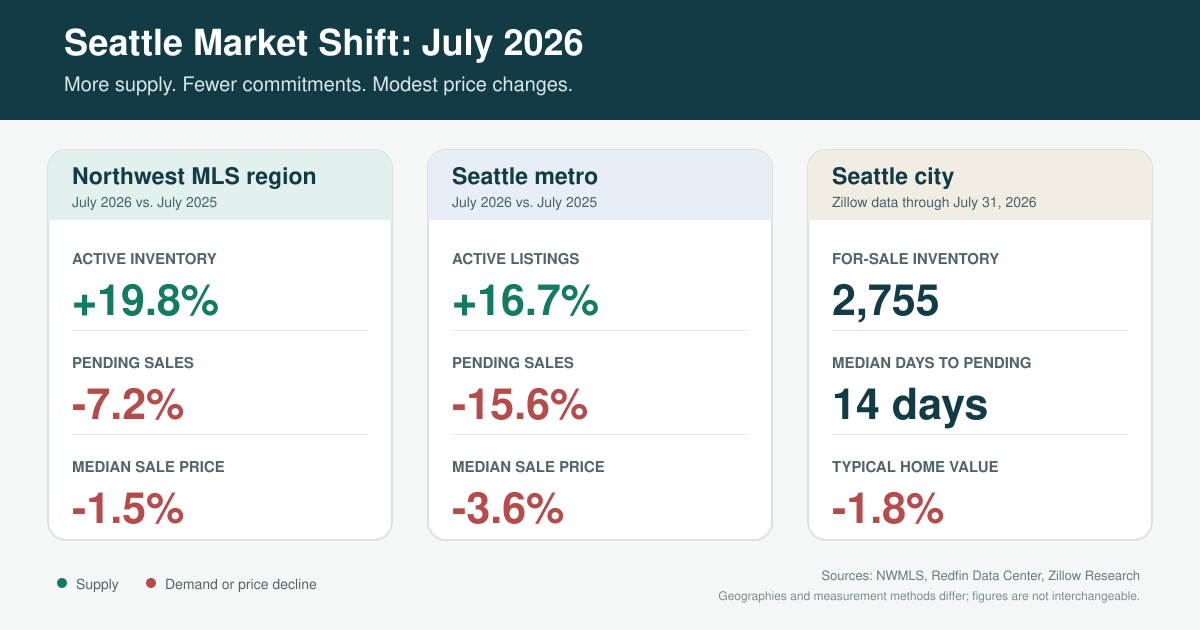
Pending sales | Northwest MLS service area | July 2026 vs. July 2025 | 7,205, down 7.2% | |
Closed sales | Northwest MLS service area | July 2026 vs. July 2025 | 6,649, down 3.2% | |
Median sale price | Northwest MLS service area | July 2026 vs. July 2025 | $640,000, down 1.5% | |
Months of inventory | Northwest MLS service area | July 2026 | 3.74 months; NWMLS describes 4 to 6 months as generally balanced | |
Active inventory change | King and Snohomish counties | July 2026 vs. July 2025 | King up 23.7%; Snohomish up 34.7% | |
Buyer-seller balance | Seattle metro | July 2026 | Redfin estimated 11,429 sellers and 6,922 buyers, or 65.1% more sellers than buyers | |
Pending and closed sales changes | Seattle metro | July 2026 vs. July 2025 | Pending sales down 15.6%; closed sales down 9.1% | |
Typical home value | Seattle city | Data through July 31, 2026 | $851,471, down 1.8% year over year | |
Above-list and below-list sales | Seattle city | Data through June 30, 2026 | 34.5% sold above list; 39.4% sold below list | |
Typical rent | Seattle city | Data through July 31, 2026 | $2,238, up 0.1% year over year | |
30-year fixed mortgage average | United States | Week ending August 13, 2026 | 6.67% |
What changed, and what did not change?
Choice changed. Northwest MLS ended July with more than 4,100 additional active listings than one year earlier. King County inventory rose 23.7%, while Snohomish County inventory rose 34.7%. Buyers can compare more properties and revisit homes that miss their first-week pricing window.
Demand changed too. Regional pending sales fell 7.2%, and Redfin's Seattle-metro measure fell 15.6%. Different boundaries and methods explain why those percentages should not be swapped. Both measures point to fewer buyers committing to purchases than a year ago.
Prices did not fall at the same pace. The Northwest MLS regional median declined only 1.5%, while Zillow's Seattle home-value measure declined 1.8%. A median or index describes a group of homes. It does not tell you what one property is worth.
Financing also remains a constraint. The national 30-year fixed mortgage average was 6.67% for the week ending August 13. That is a national benchmark, not a Seattle quote. A buyer's actual rate depends on the loan, credit profile, occupancy, property, points, and lender.
Is Seattle a buyer's market in August 2026?
Under Redfin's model, yes. Its July estimate showed 65.1% more sellers than buyers in the Seattle metro. Redfin calls a market buyer-favored when sellers exceed buyers by more than 10%. The estimate is seasonally adjusted, model-based, and subject to revision.
Under the Northwest MLS supply measure, the answer is less direct. Its full service area had 3.74 months of inventory, still below the four-to-six-month range it describes as generally balanced. That region is much larger than Seattle, so the figures answer different questions rather than canceling each other out.
Seattle-city results also show why one label is not enough. Zillow reported that 34.5% of June sales closed above list and 39.4% closed below list. Investors should read the market as property-specific: some sellers face real competition, while some listings still attract buyers quickly.
Where do investors have the most negotiating leverage?
Leverage usually appears where a seller's problem is visible. A listing may have missed its first wave of attention, need work, carry an awkward layout, or present permit and financing questions. Those details matter more than a metro-wide label when you decide whether to negotiate or move on.
Look for these signals before choosing an offer strategy:
- Longer market time than comparable properties
- One or more price reductions
- Repeated status changes or a prior failed contract
- Deferred maintenance or work that limits common financing
- Rental, permit, access, appraisal, or insurance questions
- A vacant home or a seller with a specific closing timeline
- Competing listings with better condition, pricing, or income potential
None of these signals guarantees a concession. They tell you where to ask better questions. Review the listing history, the freshest comparable sales, current competition, and the seller's priorities before deciding how much leverage the property actually offers.
What can a buyer negotiate besides the purchase price?
A lower price is only one lever. Depending on the property, seller, loan, and competing interest, an investor may get more value from terms that reduce upfront cash, protect due diligence, or improve certainty. The right combination should support the actual plan for the property.
Possible terms include:
- A seller-paid closing-cost credit or lender-approved rate buydown
- Inspection access, repair work, or a repair credit
- Appraisal protection appropriate to the financing and property
- A closing or possession date that solves a timing problem for the seller
- Clearly documented appliances or personal property
- Time to verify permits, leases, rents, utilities, insurance, or development assumptions
Ask the lender to compare a price reduction with any proposed credit or buydown. The answer depends on loan limits, underwriting, costs, and the buyer's expected hold period. Do not assume the option with the larger headline number creates the better long-term result.
What are we seeing locally at HouseHack Seattle?
In recent buyer conversations, we keep returning to three offer levers: cash, contingencies, and competency. Buyers often focus only on paying more. In practice, a well-prepared lender, complete paperwork, clear communication, sensible timing, and a thoughtful contingency plan can also make an offer easier for a seller to trust.
The slower pace gives investors more room to investigate, but it does not remove the need to perform. If a legal ADU, rental history, unfinished space, or future DADU drives the value, we want to verify that assumption before paying for it. Zoning potential and usable, financeable capacity are not the same thing.
For house hackers, more listings are useful only if the comparisons are honest. Seattle's typical rent was $2,238 in July and rose just 0.1% year over year. A thin deal should not depend on rapid rent growth, a future refinance, or appreciation to become safe.
Our basic house-hack review asks:
- Is the second unit or rental area permitted and insurable?
- What do current, comparable rents support today?
- Who pays utilities, and can usage be separated?
- What vacancy, repairs, maintenance, and capital work should the budget include?
- Does the payment still work if rents stay flat?
- Is future ADU or DADU capacity physically and financially realistic?
What should sellers do in a slower Seattle market?
Sellers still control the condition, presentation, pricing, and terms they bring to market. The July data does not mean a strong home must be discounted. It does mean buyers have more alternatives, so an unsupported price or unresolved condition issue is easier to reject.
Before listing, a seller should:
- Price from recent comparable sales and current active competition
- Separate city, county, and neighborhood data
- Address issues that may create inspection or financing friction
- Decide which credits, repairs, or timing terms are acceptable
- Compare the full strength of each offer, not only the stated price
- Reassess quickly if showings and feedback do not support the launch price
Should an investor buy now or wait?
Move forward when the property, payment, reserves, and operating plan work under today's facts. Waiting may be reasonable when the deal requires a future rate cut, aggressive rent growth, a quick refinance, or appreciation to cover a weak starting position. The market label should not make that decision for you.
More inventory creates time to compare. Use it. Verify rents, permits, condition, insurance, taxes, financing, and exit options. A slower market can improve the terms of a sound purchase, but it cannot turn weak assumptions into a sound investment.
Frequently asked questions about the Seattle housing market
Can buyers offer below asking on every Seattle home now?
No. Zillow's June data showed Seattle sales on both sides of list price: 34.5% closed above list and 39.4% below list. Price history, condition, competing interest, and seller timing should guide the offer. A broad market shift does not make every seller equally negotiable.
Why are Seattle pending sales falling faster than prices?
Sales activity can react faster than prices because buyers can pause while sellers can hold, withdraw, or wait for their preferred number. July data showed weaker commitments without a matching price decline. The mix of homes sold can also move a median even when individual property values behave differently.
Does more inventory make house hacking easier?
It gives house hackers more options to compare, which can improve the search. It does not make every option a good house hack. Verify unit legality, realistic rent, shared utilities, privacy, repairs, insurance, financing, and future work before treating a basement, ADU, duplex, or conversion idea as income.
Is a seller credit better than a price reduction?
It depends on the loan and the buyer's goal. A credit may reduce upfront costs or fund a lender-approved buydown, while a lower price reduces the financed amount. Ask the lender to calculate both choices with the same assumptions, including points, monthly payment, cash to close, and expected hold period.
Should buyers wait for mortgage rates to fall?
No one can promise the timing or size of a future rate change. The national 30-year average was 6.67% on August 13, 2026, but individual quotes vary. Buy only when today's payment and reserves work; treat a future refinance as a possible option, not a required rescue.
Why do Seattle market reports show different numbers?
They may measure different places, property types, and time periods. Seattle city, King County, the Seattle metro, and the Northwest MLS service area are not interchangeable. Some sources report medians, while others use indexes or models. Check the geography, date, definition, and revision policy before comparing figures.
What should I verify before counting rental income?
Confirm current comparable rents, unit legality, lease terms, vacancy, utilities, insurance, taxes, maintenance, repairs, and capital costs. If the plan depends on an ADU or conversion, check current zoning and site limits too. Underwrite the property with today's supported rent and test what happens if rents stay flat.
The bottom line for Seattle investors
Seattle's July 2026 market offers buyers more choice and, on many listings, more room to negotiate. It is not permission to treat every property the same. The better approach is to use broad data for context, then build the offer around the specific property's value, risks, competition, and seller.
If you are sorting through a house-hack property or deciding how to position an offer, I am always happy to talk through the numbers and the tradeoffs. No prediction is required. We can start with the property and the facts in front of us.
This article provides general educational information, not legal, tax, lending, or investment advice. Property rules, loan terms, insurance, rents, and market data can change. Confirm the details with the appropriate licensed professionals before acting.
About Michael Haas
Michael Haas is a Seattle-area real estate agent, investor, and short-term rental host behind HouseHack Seattle. He helps buyers, sellers, and small investors evaluate house hacks, rental layouts, ADU and DADU potential, offer terms, and property-level risks across Greater Seattle. His approach combines current market data with practical transaction and ownership experience.
Stay connected with insights on house hacking, local market trends and smart investing strategies. Our community of 1,000+ investors meets regularly to share practical guidance on ADUs, development, BRRRR, rentals (short‑ and long‑term), property management and more, whether you’re a first‑time buyer or a seasoned investor with multiple projects.
Follow us on social for updates, tips and event details:
Instagram: @househackseattle
Facebook: HouseHack Seattle
Youtube: @HouseHack Seattle