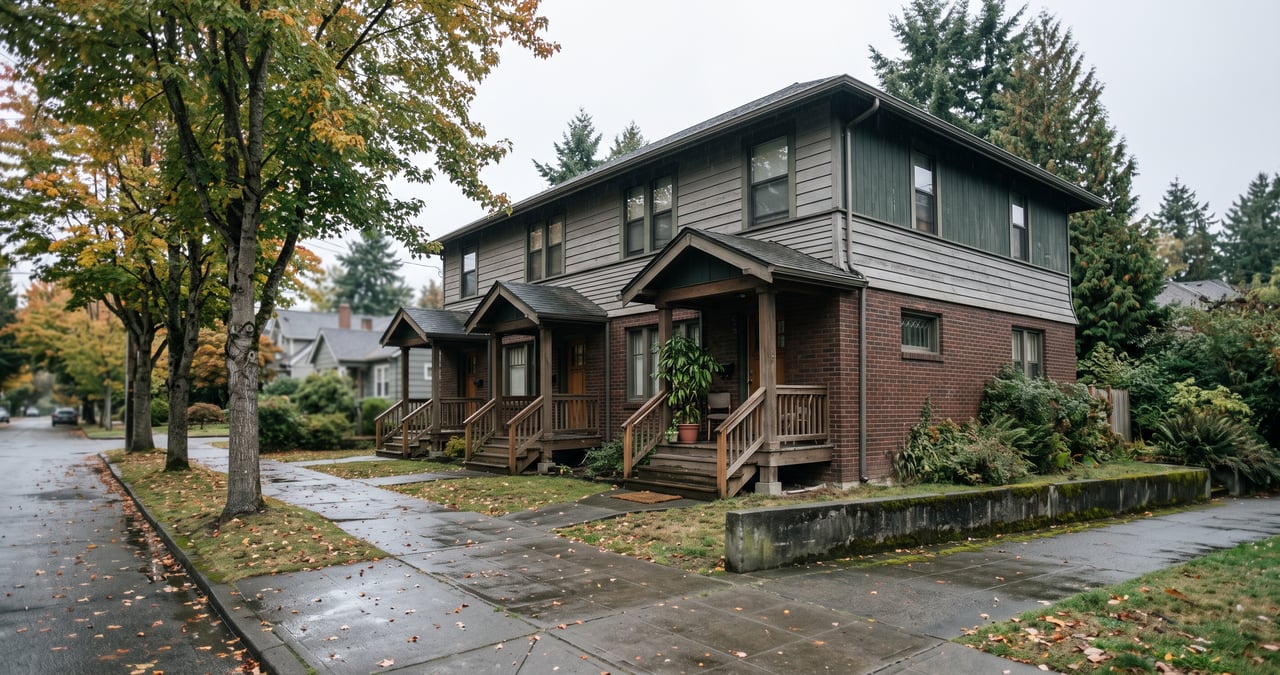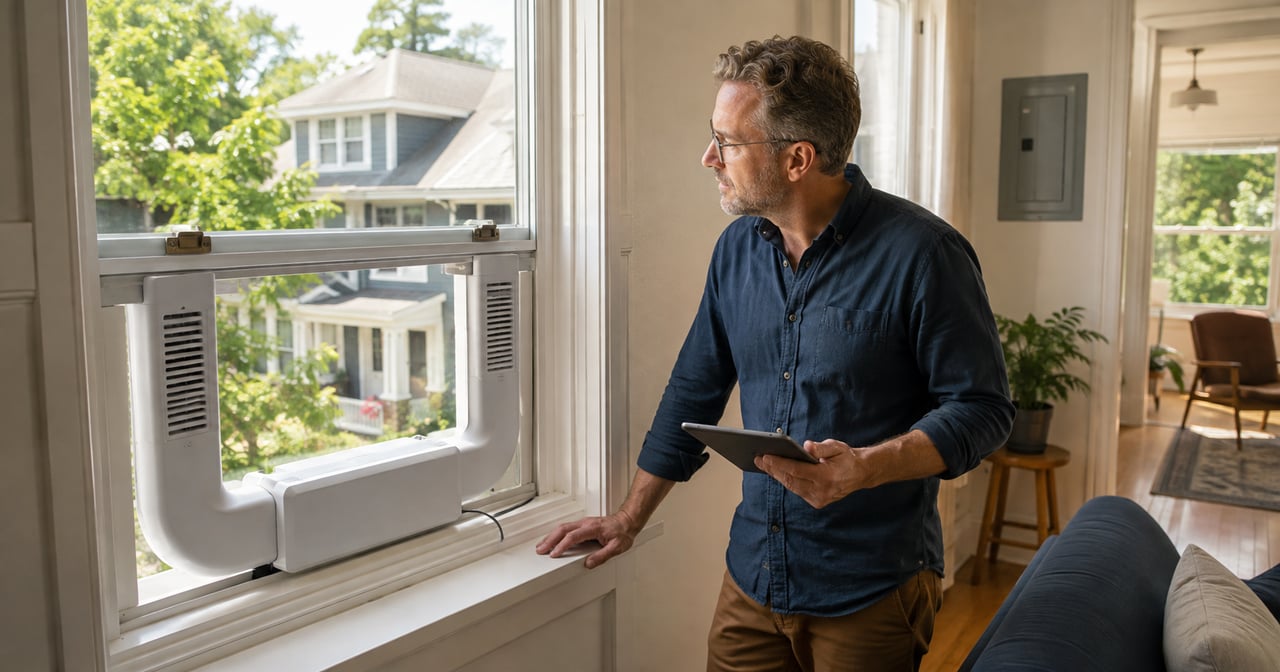
As of June 11, 2026, Washington landlords generally cannot use a blanket lease rule to ban a tenant's portable air conditioner or portable heat pump. RCW 59.18.740 still permits specific, property-based restrictions, including insufficient electrical capacity, blocked emergency egress, significant window damage, and a documented insurance prohibition.
The practical takeaway for Seattle investors is simple: replace broad bans with a unit-by-unit review and a written process. The law regulates tenant-installed devices; it does not, by its text, require a landlord to purchase a cooling device for the tenant.
Important: This article provides general educational information, not legal advice. Have a Washington landlord-tenant attorney review your lease language and any restriction involving a specific tenancy.
What does the data show about why this matters in Seattle?
The headline version of the law is that landlords can no longer ban window AC units. The useful version starts by separating two kinds of evidence: Seattle's rental-housing context and the actual statutory language.
The latest U.S. Census Bureau QuickFacts estimates show that Seattle is a majority-renter city. That does not predict how many tenants will install cooling equipment, but it does show why a change to rental operations can affect a meaningful share of the local housing market.
These figures are context, not a forecast. They tell us that rental policy is not a niche issue in Seattle. They do not tell us whether a particular property can safely support a portable AC, which is why the physical condition of the unit matters more than a general market headline.
What changed on June 11, 2026?
Engrossed Substitute Senate Bill 6200, enacted as Chapter 184, Laws of 2026, took effect on June 11, 2026. It added the portable-cooling-device rules now codified in RCW 59.18.740.
Under the statute:
A landlord generally may not prohibit or restrict a tenant's choice of portable air conditioner or portable heat pump.
A landlord may not charge a fee for the device's use, inspection, or installation.
A tenant must give at least two days' notice before installing a device that meets the statute's specific definition of a window-mounted portable cooling device.
If a landlord restricts or prohibits those window-mounted devices, the lease must explain the tenant's rights, responsibilities, and the applicable statutory restrictions.
What did not change?
The law does not remove an owner's ability to manage a real safety or property issue. It preserves defined restrictions tied to building codes, manufacturer instructions, electrical capacity, egress, window security, installation damage, fall risk, and documented insurance limitations.
It also allows landlords to seek payment for damage caused by a tenant's device and preserves lawful security-deposit deductions under RCW 59.18.280. Existing state and federal reasonable-accommodation duties also remain in place.
When can a Seattle landlord still restrict a portable AC?
The law replaces a broad yes-or-no policy with a fact-specific test. The table below summarizes the situations listed in RCW 59.18.740.
The statute also allows a landlord to require adequate drainage and to require inspection or servicing after installation for a conventional window-mounted device. The owner still cannot charge a fee for use, inspection, or installation.
Does every unit connected to a window count as "window-mounted"?
No. This is one of the most useful details in the law and an easy one to miss. For purposes of RCW 59.18.740, the defined term "window-mounted portable cooling device" excludes:
A saddle-mounted device that hangs over the sill
A U-shaped device
A floor-mounted device that connects to a window for ventilation
Those products still fall within the broader definition of a portable cooling device, but the additional rules written specifically for conventional window-mounted units do not automatically apply to them. The general limits involving code compliance, manufacturer instructions, damage, and electrical capacity still matter.
That distinction can create a practical solution. If a conventional unit would block egress or prevent a window from locking, a different device design may address the property's constraint without creating a blanket prohibition.
What does this mean for Seattle real estate investors?
This rule is unlikely to change a property's value by itself. It does change the operating system around the property: lease language, maintenance intake, insurance documentation, and the information an owner should collect during due diligence.
For an investor evaluating or operating a Seattle rental, the useful questions are:
What does each lease currently say? Remove or review any blanket ban on portable AC units. If the owner restricts conventional window-mounted devices, have counsel confirm that the lease contains the notice required by RCW 59.18.740(8).
Which windows are required for emergency egress? Do not treat every bedroom or basement window the same. Identify the required exit path for each unit before a tenant submits a request.
Can the circuit support the device? A general concern about an older building is not the same as a documented capacity problem. Map the relevant circuits and obtain an electrician's assessment where capacity is uncertain.
Can the window still lock and can the device be secured? Review ground-floor and otherwise accessible windows, fall risk, mounting instructions, and any potential warranty damage.
Where will condensation drain? Establish an acceptable drainage method that prevents water from damaging the unit, siding, or the property below.
What does the insurance policy actually say? If the carrier expressly limits window units, keep the exact policy language and provide the required written evidence to the tenant. A verbal statement that "insurance will not allow it" is not the documentation described by the law.
How will requests be handled? Create a simple written workflow for the tenant's notice, device specifications, installation review, post-installation inspection, and recordkeeping. Do not add a prohibited use, inspection, or installation fee.
How should house hackers think about the rule?
House hackers often manage smaller properties where utility systems, windows, and owner and tenant spaces are closely connected. A basement apartment may share a panel with the main home. An ADU may have limited window options. A rented bedroom may rely on one window for emergency egress.
That makes a property map more useful than a generic policy. For each rented space, note the circuit, window type, lock, egress role, drainage path, and existing cooling equipment. Owner occupancy should not be treated as an automatic reason to ignore a statewide landlord-tenant rule; confirm the legal treatment of the specific rental arrangement with counsel.
What are we seeing locally in Seattle properties?
The law has been effective only since June 11, 2026, so there is not yet a mature Seattle dataset showing dispute patterns or financial impact. We do not think investors should pretend otherwise.
For this article, HouseHack Seattle reviewed the enacted law line by line alongside current Census housing data. The operational friction is most likely to appear where an old lease template meets a property-specific constraint: a limited circuit, a required egress window, an exterior-accessible window that must lock, or an insurer's written restriction.
Consider a hypothetical Seattle house hack with a lower-level rental unit. The bedroom has one required egress window, and the unit shares an older electrical panel with the owner's space. If the tenant proposes a conventional window AC, the correct response is not an automatic yes or no.
The owner would need to answer four concrete questions:
Would that specific unit block required egress?
Can the relevant circuit support the load?
Could a floor-mounted, saddle, or U-shaped device avoid the window issue?
What notice, documentation, and inspection process does the lease require?
That is the investor lesson. Compliance is not just a paragraph added to a lease. It is an operating process connected to the actual building.
What should an owner do before the next hot-weather request?
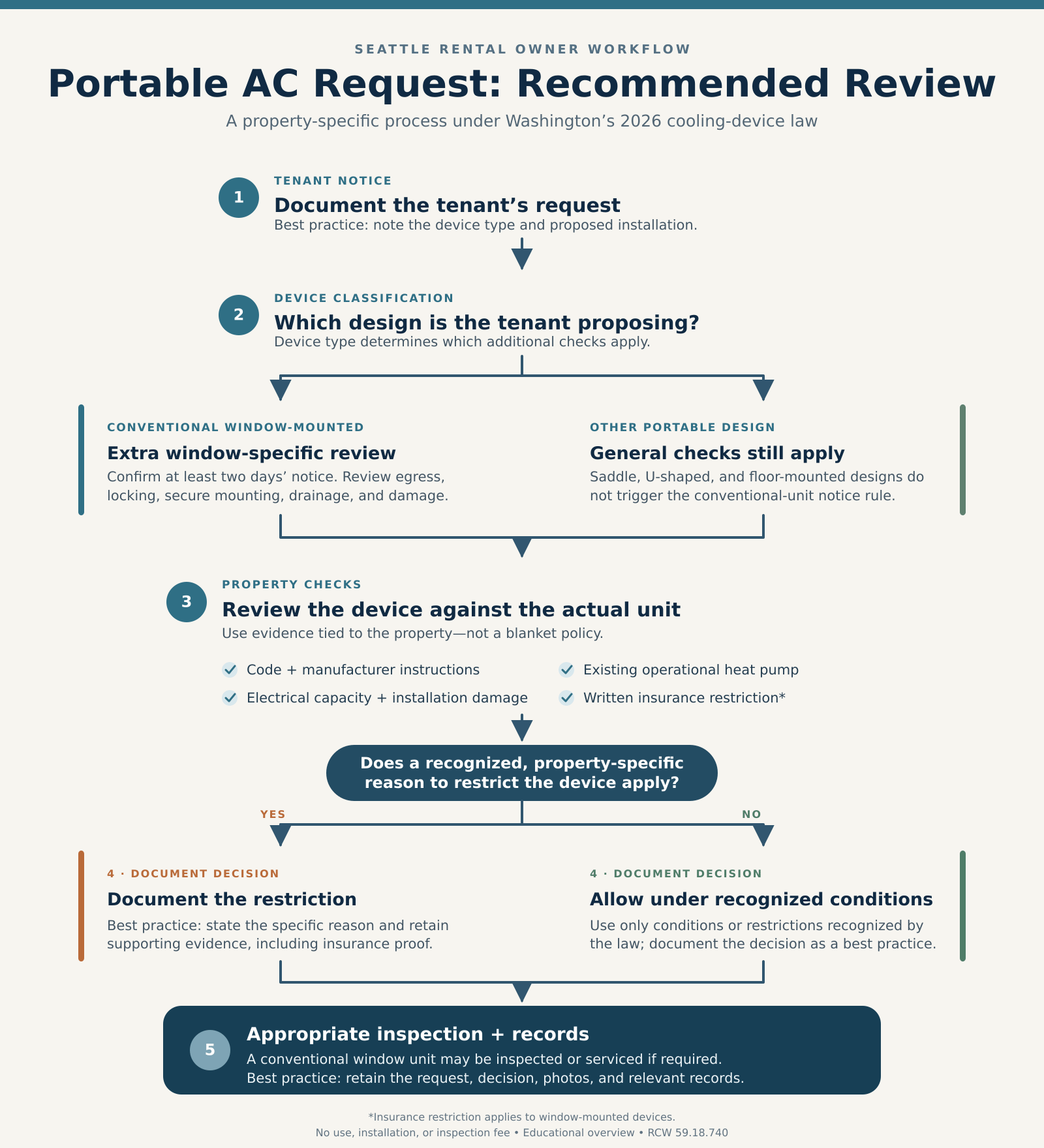
Use this as a practical review list, then have a Washington attorney adapt it to your leases:
Read RCW 59.18.740 and the enacted session law.
Flag every lease, addendum, and house rule that bans AC units or requires an AC-related fee.
Separate conventional window-mounted units from saddle, U-shaped, and floor-mounted devices.
Identify egress windows and accessible windows that must remain lockable.
Review electrical capacity by unit and circuit.
Confirm acceptable drainage and installation methods.
Ask the insurer for written policy language, not a verbal summary.
Build a written intake and inspection process that can be used consistently.
Keep device specifications, tenant notices, decisions, photographs, and inspection records together.
The goal is not to approve every device. It is to make each decision using the factors the law actually recognizes.
Frequently asked questions about portable AC rules in Washington
Can a landlord ban window AC units in Washington?
Generally, a landlord cannot impose a blanket ban on a tenant's portable cooling device. A restriction may be allowed when a condition listed in RCW 59.18.740 applies, such as blocked egress, inadequate electrical capacity, significant installation damage, fall risk, or a documented insurance prohibition.
Can a Washington landlord charge a tenant an AC fee?
The statute says a landlord may not charge a fee for a portable cooling device's use, inspection, or installation. It does allow a landlord to charge rent for a device the landlord rents to the tenant and to pursue payment for damage caused by the tenant's device.
How much notice must a tenant give before installing a window AC?
A tenant must provide at least two days' notice before installing a device that meets the statute's definition of a window-mounted portable cooling device. Because the law excludes saddle, U-shaped, and floor-mounted ventilation units from that defined term, owners should have counsel make sure their notice process distinguishes device types correctly.
Does the law require a landlord to provide air conditioning?
RCW 59.18.740 addresses a tenant's ability to install a portable cooling device. The statute does not direct a landlord to purchase or install one. Other lease terms, building requirements, or reasonable-accommodation duties may affect a specific situation.
Can a landlord reject a device because the electrical panel is old?
Age alone is not the statutory test. The law allows a restriction when the existing service to the building, dwelling unit, or circuit cannot accommodate the required power. A property-specific electrical assessment is more useful than a general assumption.
Can a landlord require an inspection after installation?
Yes. The law permits a landlord to require inspection or servicing after installation for a conventional window-mounted portable cooling device. It separately prohibits charging the tenant a fee for inspection.
What if the landlord's insurance company prohibits window units?
A restriction may be allowed if the policy for the tenant's dwelling expressly restricts or prohibits window-mounted portable cooling devices. The landlord must provide the tenant with written evidence of the insurance restriction or prohibition.
Does this law apply only in Seattle?
No. RCW 59.18.740 is a Washington state law. Seattle investors still need to consider applicable local building and safety rules because the statute expressly preserves restrictions when an installation would violate state, local, or federal law.
What is the grounded takeaway for Seattle investors?
Washington's new rule does not mean every portable AC installation must be approved. It means the decision should be tied to the device and the property, not a blanket sentence copied into every lease.
For investors, the durable response is a cleaner operating file: current lease language, mapped circuits and egress windows, written insurance evidence, and a consistent notice and inspection process. If you are reviewing a Seattle rental and want to compare how these property constraints could affect the investment plan, HouseHack Seattle is always open to a practical conversation.
Author Bio
Michael Haas is the founder of HouseHack Seattle and a Seattle-area real estate broker focused on house hacking and investment property. He has been involved in more than 400 real estate transactions, with roughly 70% involving investment properties, and has owned and operated more than 10 short-term rentals. Through client work and the HouseHack Seattle investor community, Michael studies how financing, zoning, operations, and local regulation affect real properties and real decisions.
--
Stay connected with insights on house hacking, local market trends and smart investing strategies. Our community of 1,000+ investors meets regularly to share practical guidance on ADUs, development, BRRRR, rentals (short‑ and long‑term), property management and more, whether you’re a first‑time buyer or a seasoned investor with multiple projects.
Follow us on social for updates, tips and event details:
Instagram: @househackseattle
Facebook: HouseHack Seattle
Youtube: @HouseHack Seattle