House hacking is often marketed as a near-guaranteed way to live cheaply or even for free by renting out part of your home. In Seattle, the strategy can work well. But it doesn’t always. Some house hacks underperform or lose money entirely not because the concept is flawed, but because the assumptions behind the deal were wrong.
This article breaks down the most common reasons Seattle house hacks lose money, using local rules, publicly available data, and conservative underwriting assumptions plus how to avoid these mistakes before you buy or build.
Important note:
This article is for educational purposes only. All figures are examples based on public data and commonly observed ranges. Actual results vary by property, financing terms, construction costs, and market conditions.
Overestimating Rent (and Underestimating Vacancy)
Many house hacks fail because projected rent assumes:
-
Top-of-market pricing
-
Zero vacancy
-
No turnover or re-leasing costs
In reality, Seattle rental performance varies block by block. Rent is influenced by:
-
Unit size and layout
-
Parking availability
-
Privacy (especially ADUs vs. DADUs)
-
Tenant turnover frequency
Public rent benchmarks (not guarantees):
How to reduce risk:
-
Underwrite rent at 5–10% below comparable listings
-
Include at least 5% vacancy
-
Budget for turnover, maintenance, and leasing costs
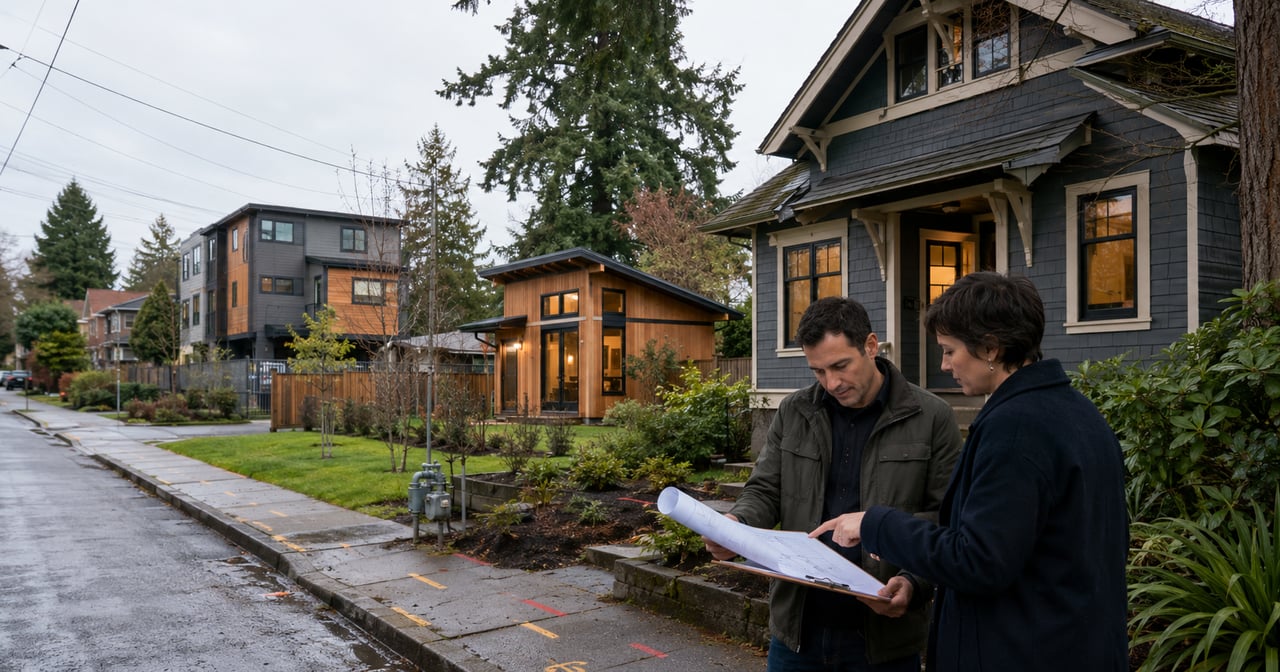
Underestimating Build & Renovation Costs
Construction costs in Seattle are rarely “average,” especially for ADUs and DADUs.
Commonly overlooked expenses include:
-
Utility connections (water, sewer, power)
-
Site work, grading, and drainage
-
Design revisions during permitting
-
Permit review timelines and delays
-
Interest carry during construction
City of Seattle ADU/DADU guidance (primary source)
Why this matters:
Even modest cost overruns can turn a marginally positive house hack into a loss—particularly in the early years.
Ignoring Financing Reality (Especially FHA & Owner-Occupancy)
Many house hackers rely on:
-
FHA loans
-
Low down payments
-
Owner-occupancy strategies
What’s often missed:
-
FHA loans generally require at least one year of owner occupancy
-
Rental income may not fully count toward loan qualification
-
Mortgage insurance increases monthly housing costs
Freddie Mac rental income guidance
How to reduce risk:
-
Confirm income treatment with a lender before making an offer
-
Run numbers assuming no rental income is approved
-
Stress-test payments at higher interest rates
Choosing the Wrong Property Type or Layout
Not all “house-hackable” properties perform equally.
Common underperformers include:
-
Basement units with low ceiling height
-
Shared entrances with limited separation
-
Properties without parking in parking-constrained areas
-
Poor sound insulation between units
Seattle renters consistently value:
-
Privacy
-
Natural light
-
Separate entrances
Seattle zoning & housing rules
Treating House Hacking as Passive Income
House hacking is not passive, especially in the first few years.
Costs that are often ignored:
-
Time spent managing tenants
-
Repairs while living onsite
-
Conflict resolution
-
Ongoing compliance and safety upgrades
Failing to account for time, stress, and management effort can make a “break-even” deal feel like a loss.
Example Comparison Table
| Factor | Conservative Assumption | Optimistic Assumption |
|---|---|---|
| Monthly Rent | Below-market | Top-of-market |
| Vacancy Rate | 5–8% | 0% |
| Build Cost | High-range estimate | Low-range estimate |
| Financing | Full payment responsibility | Partial income counted |
| Outcome | Stable, predictable | Higher risk of loss |
Key Takeaways
House hacking can be a powerful way to reduce housing costs and build long-term wealth in Seattle but only when the deal is evaluated honestly. Conservative assumptions, local zoning knowledge, and financing clarity matter more than creative math.
If a house hack only works under perfect conditions, it’s usually a sign the risk is higher than it appears. The strongest deals tend to hold up even when assumptions are tightened.
Understanding these tradeoffs before buying or building can save years of frustration and help you move forward with clearer expectations.
Stay connected with insights on house hacking, local market trends and smart investing strategies. Our community of 1,000+ investors meets regularly to share practical guidance on ADUs, development, BRRRR, rentals (short‑ and long‑term), property management and more, whether you’re a first‑time buyer or a seasoned investor with multiple projects.
Follow us on social for updates, tips and event details:
Instagram: @househackseattle
Facebook: HouseHack Seattle
Youtube: @HouseHack Seattle