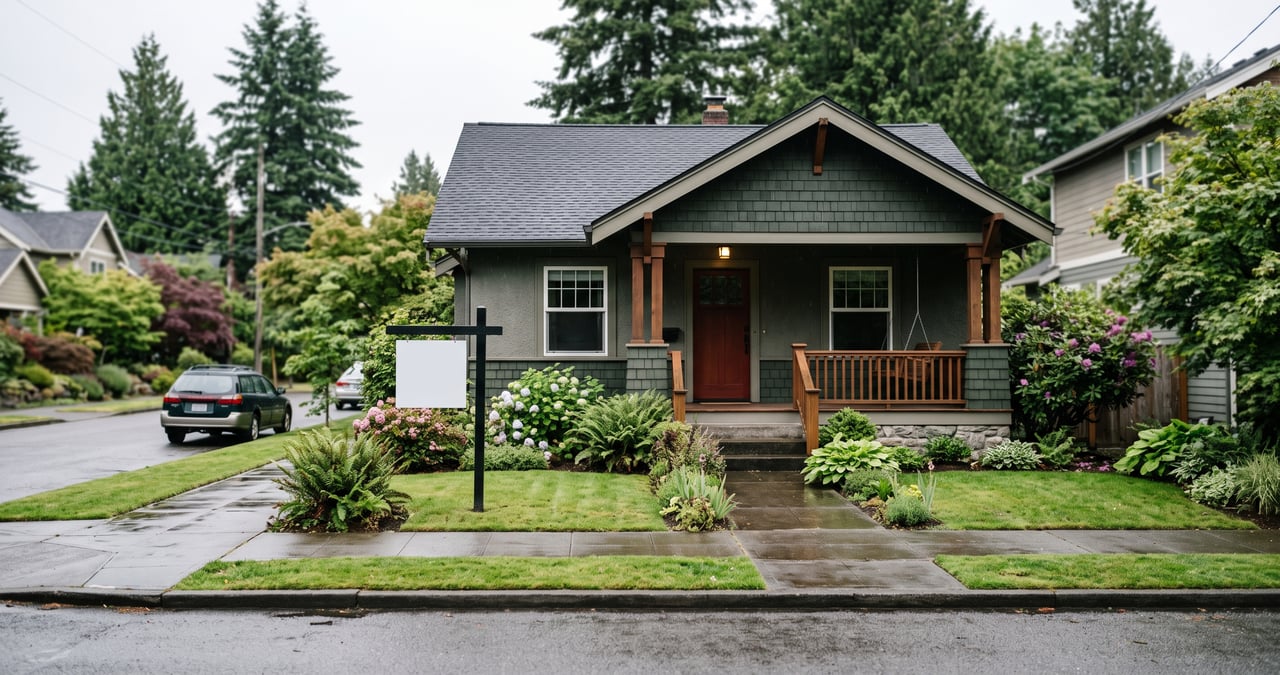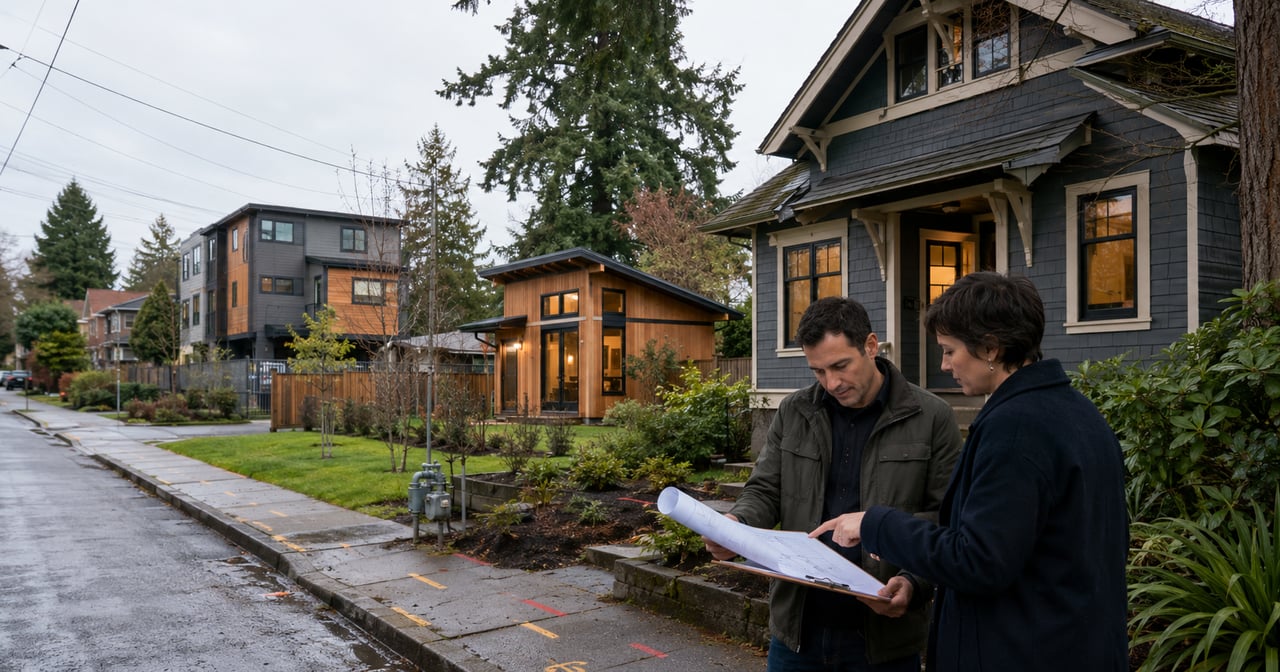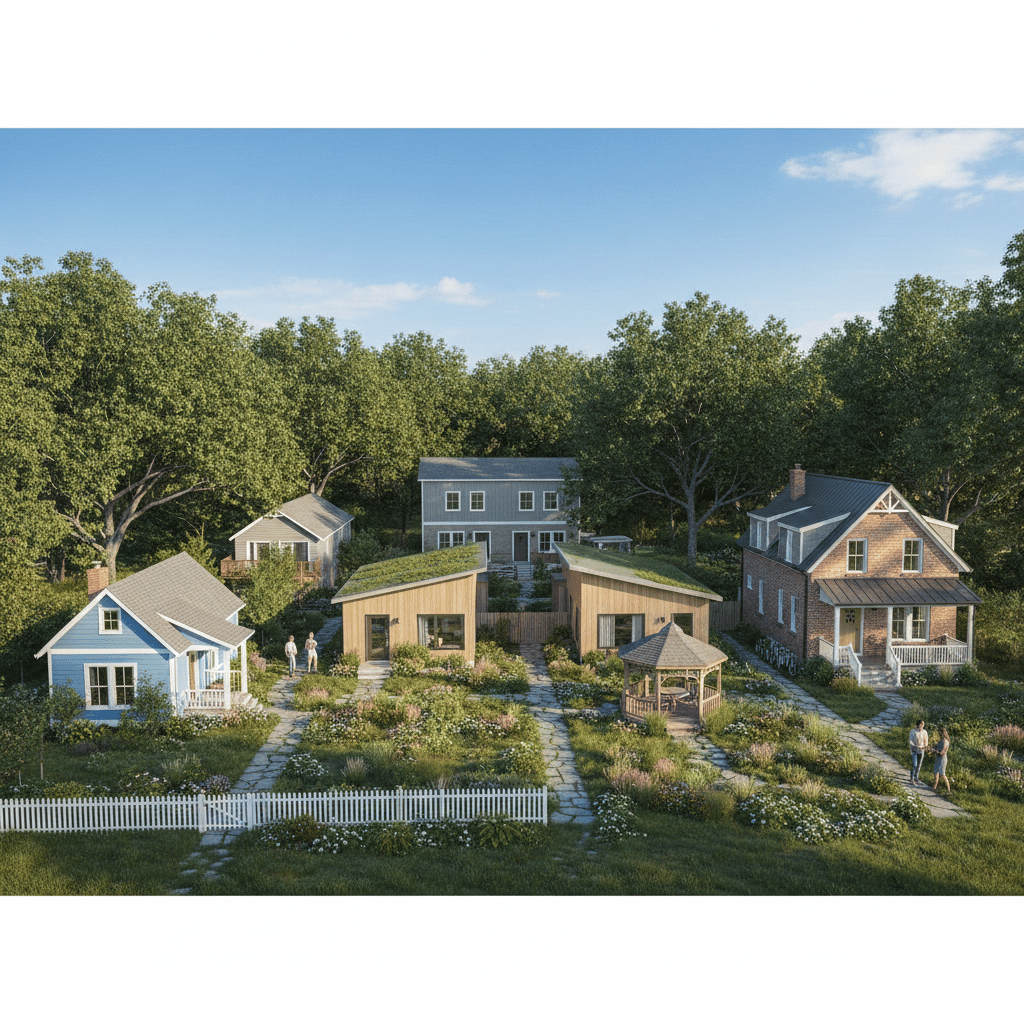
In real‑estate development, a project is said to “pencil” when the numbers make sense the expected income or value is high enough to justify the cost. For years, many homes in Seattle’s single‑family zones did not pencil for adding accessory dwelling units (ADUs) or additional homes because zoning severely limited how much of a lot could be built on. The typical Neighborhood Residential (NR) lot could cover only 35 % of its area with structures, leaving little room after a primary house. Recent zoning reforms – adopted to comply with Washington State’s “middle housing” law (HB 1110) – change that calculus. Under the new rules, Seattle lots with multiple units may cover 50 % of the lot, and most properties can host four homes by right. This shift may make previously infeasible projects financially viable.
What Changed in Seattle’s Code (High Level)
Seattle replaced single‑family zoning with Neighborhood Residential (NR) zoning in 2025. The city adopted interim legislation (Council Bill 120969) in June 2025 and a permanent update in February 2026. The key changes include:
Increased Unit Counts
-
Four units allowed on every NR lot: Seattle now permits at least four homes on any residential lot, regardless of lot size. The density may be higher if the lot is large enough – up to one unit per 1,250 sq ft – or if the property is within a quarter‑mile of a major transit stop. In practice, lots near transit or with affordable units can host up to six units.
-
Accessory dwelling units (ADUs): Homeowners may build two ADUs per lot (attached, detached or both), and there is no longer an owner‑occupancy or parking requirement. ADUs now count toward the overall unit count but are not capped separately.
Higher Lot‑Coverage Limits (Under Specific Conditions)
-
50 % lot coverage for multiple units: The Seattle Municipal Code now allows structures to cover 50 % of the lot area when the lot contains two or more principal and detached accessory dwelling units. Previously, most lots were limited to 35 % coverage, or 15 % + 1,000 sq ft on lots under 5,000 sq ft. The 50 % rule applies only when multiple principal dwellings and detached ADUs are built; single‑unit lots still follow the 35 % or 1,000 sq ft + 15 % limit.
-
Coverage bonuses for stacked flats and cottage housing: Permanent legislation also creates 60 % lot‑coverage allowances for stacked flats (multi‑story apartment‑style units) or cottage‑housing clusters that meet certain design and setback criteria. These bonuses encourage diverse housing types but come with requirements, such as larger amenity areas and front setbacks.
New Floor‑Area Ratio (FAR) System
Instead of relying solely on lot coverage, Seattle now uses Floor‑Area Ratio (FAR) to regulate building bulk. FAR limits scale with density: lots with four to six units may build up to 1.2–1.6× the lot area, while less dense projects have lower FAR limits. FAR is paired with setbacks and height limits to manage scale and maintain neighborhood character.
Why Lots That Didn’t Pencil Before May Pencil Now
The shift from 35 % to 50 % lot coverage and the ability to build four or more units significantly improves development feasibility on many Seattle lots:
-
More buildable area. On a 5,000 sq ft lot, the old 35 % cap allowed roughly 1,750 sq ft of building footprint. After accounting for a primary house (often 1,500–1,800 sq ft), only a few hundred square feet remained for an ADU. The new 50 % cap yields 2,500 sq ft of footprint an extra 750 sq ft making it possible to fit two additional units instead of one. Smaller lots also benefit because the maximum lot coverage can now reach 50 % (instead of being capped at 35 %) when multiple dwellings are constructed.
-
Economies of scale. Building more units spreads land acquisition and infrastructure costs across additional homes. For example, adding two small cottages or a duplex can generate rental income or sale proceeds that offset construction costs, making the project “pencil” when a single ADU would not.
-
Expanded housing types. The code now allows stacked flats, duplexes, fourplexes, cottage clusters and other “middle housing” on most lots. These building types can be more efficient than detached cottages because they stack floor area vertically; they also qualify for higher FAR and sometimes greater lot coverage..
-
Market demand. Seattle remains a high‑demand housing market with limited supply. Being able to add legal, code‑compliant units can create rental income or equity in a way that was not possible when zoning only allowed a single house and one or two small ADUs.
What This Means for Homeowners, Buyers and Investors
Homeowners Considering ADUs or Redevelopment
-
Build more than one ADU. You may now add both an attached and a detached ADU—and they can be legal principal dwellings rather than “accessory” units. If the lot includes two or more principal dwellings plus a detached ADU, the 50 % coverage rule applies.
-
Evaluate whether to replace or expand. On undersized lots, tearing down and rebuilding a primary house might free up footprint for multiple smaller units. Conversely, some homeowners may choose to retain the existing home and add a duplex or cottages behind it.
-
Engage professionals early. The new regulations are complex. An architect or land‑use consultant familiar with Seattle’s updated code can help determine setbacks, FAR, tree retention requirements and amenity‑area rules.
Buyers Exploring House Hacking
-
Look for transit bonuses. Properties within a quarter‑mile of major transit stops may support up to six units. These sites offer higher density, making it easier to live in one unit while renting the others.
-
Budget for Mandatory Housing Affordability (MHA). Projects adding extra units must either include an affordable unit or pay an in‑lieu fee. Factor these costs into your feasibility analysis.
-
Understand financing. Lenders may treat multifamily projects differently from single‑family homes. Buyers should consult mortgage brokers experienced in ADU and small‑multifamily financing.
Small Investors or Builders Evaluating Infill Projects
-
Density vs. design. Fourplexes or cottage clusters can maximize unit count, but stacked flats (which can go up to 60 % lot coverage and 1.8 FAR in some cases) may yield more square footage. Choose a building type that fits the neighborhood context and market demand.
-
Site constraints still matter. Critical areas (e.g., wetlands, steep slopes and riparian corridors) are excluded from the 50 % coverage calculation. Urban lots may also have tree preservation requirements and minimum open‑space (amenity area) standards.
-
Consider subdivision. Seattle plans to allow lot splitting under certain conditions in 2026. A subdivision could enable separate ownership of individual homes, providing more exit options but adding complexity.
What Has NOT Changed
Despite the reforms, several constraints remain and must be acknowledged:
-
Financing and construction costs. Higher interest rates, rising construction costs and labor shortages still affect project feasibility. More units help, but they do not eliminate financial risks.
-
Setbacks and height limits. Front, side and rear setbacks still apply, although some have been reduced for lots with three or more units (e.g., 10‑ft front setback and 10‑ft rear setback for lots without alleys). Height limits remain around 32 ft (with allowances for pitched roofs).
-
Environmental and design standards. Tree preservation, amenity‑area requirements and design review still apply. The 50 % coverage does not apply to portions of the lot in critical areas such as wetlands or riparian corridors.
-
Owner goals. Not everyone wants to maximize unit count. Some homeowners may prioritize yard space, gardens or privacy over additional units.
How to Evaluate a Lot Safely
Before committing to a development project, follow this checklist:
-
Confirm zoning designation. Use the City’s Interactive Zoning Map to verify that a property is within an NR zone and to check overlays (transit proximity, frequent‑transit service areas, etc.).
-
Verify lot size and existing structures. Lot coverage calculations depend on the size of the lot and the number of existing dwellings. Small lots (< 5,000 sq ft) have different coverage calculations for single‑unit projects.
-
Review coverage and FAR rules for the planned unit count. If planning two or more principal dwellings, note the 50 % coverage rule. For stacked flats or cottage housing, check whether 60 % coverage and higher FAR apply.
-
Understand density allowances. Determine whether the lot is eligible for four units by right or up to six units via the transit or affordability bonus.
-
Check setbacks and height limits. Confirm whether reduced setbacks apply (10 ft front and rear for three or more units) and what height limits govern the site.
-
Consult professionals. Hire an architect, land‑use attorney or experienced builder to interpret the code, manage permits and conduct a feasibility analysis. Professionals can help navigate tree preservation, critical area exceptions and MHA obligations.
Seattle’s zoning reforms are a significant shift from the city’s single‑family past. By allowing four or more homes on every residential lot and permitting 50 % lot coverage when multiple principal dwellings and detached ADUs are built, the city has created new opportunities for homeowners, buyers and investors. Lots that previously could not accommodate more than one house and a small ADU may now fit duplexes, fourplexes or cottage clusters. However, feasibility still depends on site conditions, financing, and careful planning. As always, verify the latest regulations with the City of Seattle and consult qualified professionals before proceeding.
This article is for informational purposes only and should not be considered legal, zoning, or financial advice. Development feasibility varies by property, zoning and site conditions. Always verify applicable regulations with the City of Seattle and consult qualified professionals before making real‑estate decisions.
Stay connected with insights on house hacking, local market trends and smart investing strategies. Our community of 1,000+ investors meets regularly to share practical guidance on ADUs, development, BRRRR, rentals (short‑ and long‑term), property management and more, whether you’re a first‑time buyer or a seasoned investor with multiple projects.
Follow us on social for updates, tips and event details:
Instagram: @househackseattle
Facebook: HouseHack Seattle
Youtube: @HouseHack Seattle