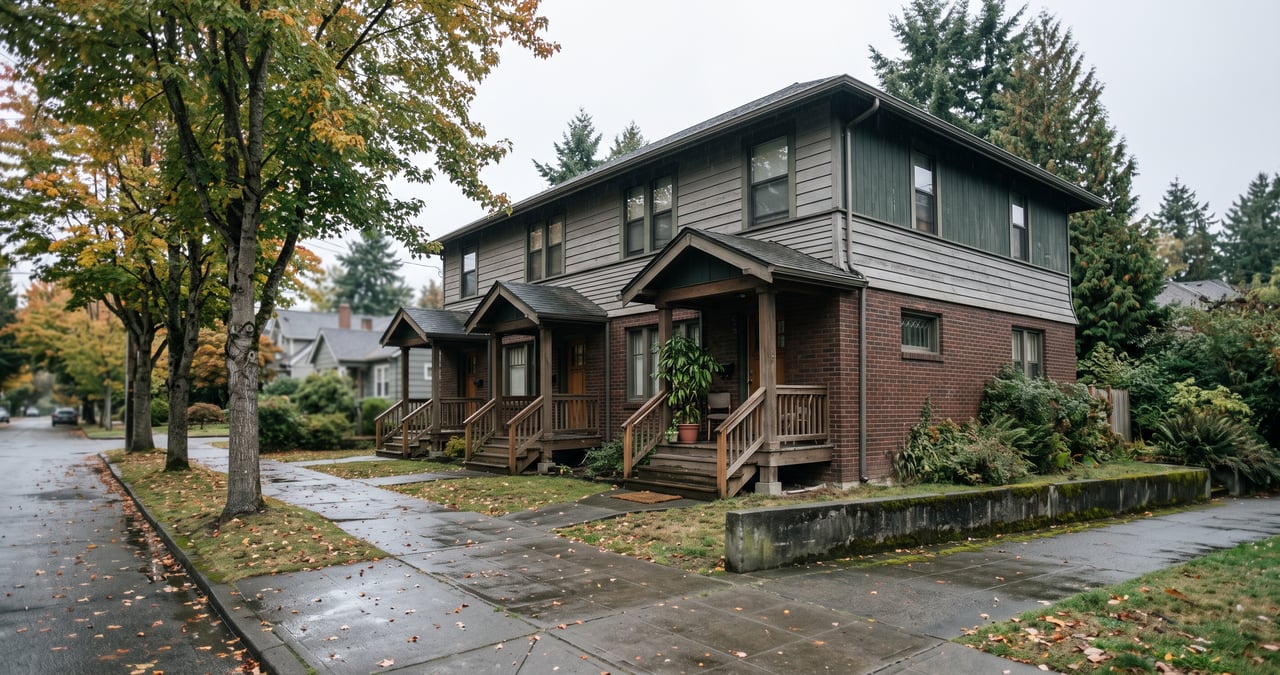
Why Charts Claiming Stocks Beat Seattle Real Estate Mislead
Introduction
Social media is littered with simple charts claiming that “stocks beat real estate.” Those graphics typically compare an all‑cash purchase of a home to an investment in the S&P 500. In reality, hardly anyone buys investment property with 100 % cash in Seattle or anywhere else. Serious investors use mortgages, tax strategy and long time horizons to build wealth. That means headline‑ready comparisons can be deeply misleading. In uncertain markets like ours, good decisions start with data, not noise.
What the Data Shows
Seattle’s housing market cooled slightly at the start of 2026. Redfin’s February 2026 update reports a median sale price of $850 k in Seattle, down 0.29 % year‑over‑year with homes selling in 21 days and 587 homes sold, about 8 % fewer than a year ago. Northwest MLS data show the median price across its counties at $620 k in February 2026, 1.6 % lower than February 2025; King County’s median sale price was $840 k. Inventory, however, rose nearly 28 % year‑over‑year as more sellers entered the market.
Over the long term, Seattle real estate has compounded far faster than those recent headlines suggest. The Case‑Shiller low‑tier home price index for Seattle climbed from 165.82 in January 2015 to 426.44 in December 2025 more than doubling in a decade. During the same period, the stock market delivered strong but volatile results. The S&P 500 total return index produced double‑digit gains in most years, including 17.88 % in 2025, 25.02 % in 2024 and 26.29 % in 2023, but also sharp declines such as ‑18.11 % in 2022. These swings remind investors that equity markets do not march upward in a straight line.
Key Metrics
| Metric | Value | Geography | Timeframe | Source |
|---|---|---|---|---|
| Median sale price (all homes) | $850,000 | Seattle, WA | Feb 2026 | Redfin Seattle housing market |
| YoY change in median sale price | ‑0.29 % | Seattle, WA | Feb 2026 vs Feb 2025 | Redfin |
| Median days on market | 21 days | Seattle, WA | Feb 2026 | Redfin |
| Homes sold | 587 | Seattle, WA | Feb 2026 | Redfin |
| NWMLS median sale price | $620,000 | NWMLS counties | Feb 2026 | NWMLS monthly market snapshot |
| YoY change in NWMLS median price | ‑1.6 % | NWMLS counties | Feb 2026 vs Feb 2025 | NWMLS |
| King County median price | $840,000 | King County | Feb 2026 | NWMLS |
| Case‑Shiller Seattle HPI (low tier) | 165.82 → 426.44 | Seattle, WA | Jan 2015 → Dec 2025 | FRED Case‑Shiller Seattle index |
| S&P 500 total return (2025) | 17.88 % | United States | 2025 | Slickcharts S&P 500 returns |
| S&P 500 total return (2024) | 25.02 % | United States | 2024 | Slickcharts |
| S&P 500 total return (2022) | ‑18.11 % | United States | 2022 | Slickcharts |
What This Means for Investors
Those viral charts typically assume you buy a property with cash and hold it for price appreciation alone. In the real world, investors finance their purchases. A 20 % down payment on a $1 million property requires $200 k of your capital and an $800 k mortgage. If that property appreciates 4 % in the first year, its value rises to $1.04 million - a $40 k gain on your $200 k equity, or 20 % return before factoring in loan pay‑down. The same $200 k placed in the S&P 500 during 2025 would have produced $35,760 at a 17.88 % total return. Leverage amplifies modest real‑estate appreciation into equity growth that rivals or exceeds stock returns. It also cuts both ways: if home prices drop, the loss relative to your equity is magnified.
Tax policy further tilts the scales. Mortgage interest on up to $750,000 of acquisition debt remains deductible, and state and local taxes (including property taxes) are deductible up to $10,000. When you sell a primary residence you may exclude up to $250,000 of capital gains if single or $500,000 if married filing jointly. By contrast, long‑term stock gains are subject to federal tax of 0 %, 15 % or 20 % based on your income, with an additional 3.8 % net investment income tax for high earners. This means the after‑tax proceeds from a successful real‑estate exit can be materially higher than those from an equivalent stock investment.
Real estate also allows investors to force appreciation through renovation or repositioning adding $150 k of value with a $50 k project is not uncommon in Seattle’s older housing stock. Stocks offer no comparable way to improve the underlying asset. And finally, IRS Section 1031 exchanges let you defer capital gains tax by rolling proceeds into another investment property, enabling long‑term portfolio growth without triggering immediate tax liability.
What We’re Seeing Locally
HouseHack’s community conversations reflect a market in flux. Rising inventory and slightly longer days on market have created more breathing room for buyers, but well‑priced homes in desirable neighborhoods still attract multiple offers. Many investors are focusing on value‑add properties homes where strategic renovations can create equity and higher rents. Others are preparing to execute 1031 exchanges out of out‑of‑state holdings into Seattle neighborhoods they know well. High interest rates have increased holding costs, so successful investors are stress‑testing deals at conservative rent and appreciation assumptions. The overall tone is cautious optimism: the fundamentals of the Seattle economy tech employment, limited buildable land and continued population growth remain supportive, but due diligence and discipline are essential.
Conclusion
Comparing stocks and real estate isn’t as simple as plotting two lines on a chart. Leverage, tax treatment and local market dynamics make direct comparisons misleading. Data from Seattle’s housing market shows modest year‑over‑year price declines but substantial long‑term appreciation, while the stock market alternates between big gains and sharp corrections. Savvy investors use financing to control large assets with limited capital, take advantage of deductions and exclusions, and look for opportunities to add value. The takeaway? Don’t let a viral chart set your strategy. Dive into the numbers, understand your options and invest with a long view. If you’re navigating the Seattle market and want to discuss strategy, HouseHack Seattle is here for an open, data‑driven conversation.
Stay connected with insights on house hacking, local market trends and smart investing strategies. Our community of 1,000+ investors meets regularly to share practical guidance on ADUs, development, BRRRR, rentals (short‑ and long‑term), property management and more, whether you’re a first‑time buyer or a seasoned investor with multiple projects.
Follow us on social for updates, tips and event details:
Instagram: @househackseattle
Facebook: HouseHack Seattle
Youtube: @HouseHack Seattle